
Musk discloses Colossus 2's year-end configuration
Elon Musk, who leads SpaceXAI (formerly xAI), the AI company under SpaceX, posted on X on Oct. 31 (Nov. 1 Japan time) that the company's "Colossus 2" data center in Memphis, Tennessee, will hold a total of about 1.2 million NVIDIA "Blackwell"-generation GPUs (chips used for AI computation) by the end of the year.
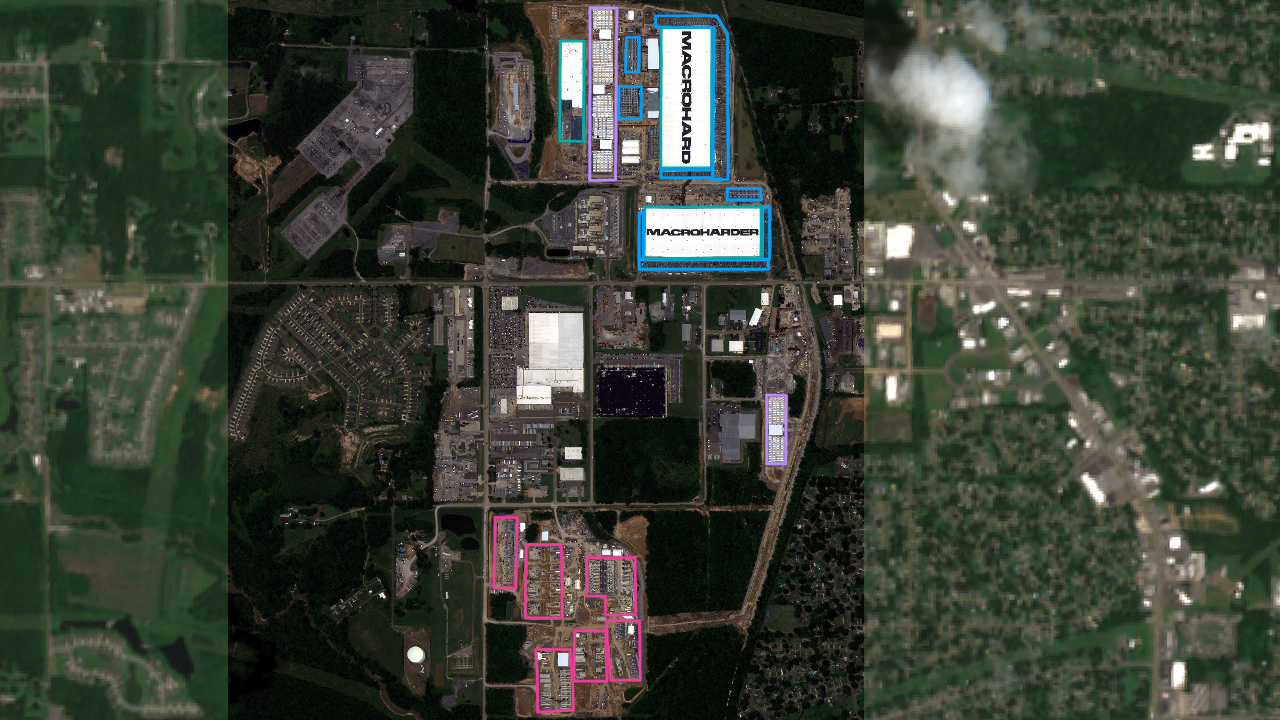
According to the posts, the "Macroharder" and "Minihard" buildings, used for AI training, each hold 220,000 NVIDIA "GB300" units. "Gun Range," being built on land that was formerly a local police shooting range, will have the same configuration and is expected to come online at the end of November. "Spam," which uses a building that once stored products of food company Hormel, will have about 200,000 units and will be brought online in December. Spam will be configured for inference, running already trained AI, and Musk explained that it will have "much simpler networking and less than half the fiber" of training.
Macroharder and Minihard both have 220k GB300s with 800 gig nics configured for training. Gun Range will have the same. Spam (used to house Hormel products) will have ~200k GB300s, but configured for inference, so much simpler networking and less than half the fiber.
There will be a total of around 1.2M Blackwells at Colossus 2 by end of year
Plan for 1.21 million by year-end, laid out in September, maintained
Musk had posted on Sept. 24 (Sept. 25 Japan time) that a total of 550,000 units, 110,000 "GB200" and 440,000 "GB300," were running at Colossus 2. He then laid out a plan to add 220,000 GB300s at a time in three stages, the following week, in November and at the end of December, bringing the total to about 1.21 million by the end of the year. He attached the condition "if we get lucky" to the end-of-December batch.
Colossus 1 is 150k H100, 50k H200 and 30k GB200. Colossus 2 is 110k GB200 and 440k GB300. Another 220k GB300 will be fully operational next week and another 220k in November. If we get lucky, yet another 220k GB300 by late December.
The latest posts maintained this year-end scale. The December batch is slightly smaller at about 200,000, and its use for inference was made clear. The roughly 230,000 units at the neighboring "Colossus 1," which came online in 2024 (150,000 H100s, 50,000 H200s and 30,000 GB200s), are not included in the 1.2 million, and the two combined come to about 1.44 million.
The four buildings named in the latest posts total about 860,000 units, and the breakdown of the gap with 1.2 million was not given. Business commentary site FourWeekMBA calculated this from the figures in the posts.
Third-party estimates also rank its computing power as the world's largest
U.S. research institute Epoch AI estimates the scale of companies' data centers from satellite imagery and disclosures. Colossus 2's computing power is equivalent to about 1.11 million NVIDIA "H100" units, the unit used to compare different chip types on an equal basis, making it the largest of the data centers worldwide that Epoch tracks. It estimates that Amazon's Indiana site used by Anthropic is equivalent to about 820,000 units, and the "Stargate" site in Abilene, Texas, used by OpenAI to about 760,000 units.
In terms of power, Amazon's Indiana site, at 1,037 megawatts, exceeds Colossus 2's 946 megawatts. Epoch expects Colossus 2 to reach 1,531 megawatts, equivalent to about 1.82 million H100s, by the end of February 2027. Epoch's figures for Colossus 2 are estimates as of July 30 and do not reflect later expansion.
Epoch's estimates were updated on different dates for each site: July 30 for Colossus 2, Oct. 19 for the Amazon site, July 17 for the Microsoft site, Oct. 28 for the OpenAI site and Oct. 2 for the Meta site.
Renting out computing makes AI the largest division
The added computing resources go not only toward developing SpaceXAI's conversational AI "Grok" but also toward renting to other companies. In May, Anthropic signed a contract to rent the entire capacity of Colossus 1 for $1.25 billion a month. Google also signed a contract in June to use SpaceXAI's data centers for $920 million a month. Both contracts can be canceled with 90 days' notice. Musk has said the company may take back computing resources if it runs short of capacity.
In SpaceX's results for the July-September quarter of 2026, announced on Oct. 20, the AI division accounted for $7.56 billion of $14.6 billion in revenue, surpassing the communications division that includes satellite internet service Starlink ($5.25 billion) to become the largest division. Capital spending was $19.6 billion, of which the AI division accounted for $16.4 billion. The company expects to spend $35 billion to $40 billion in the October-December quarter alone.
It is also lining up financing. On Oct. 26, SpaceX disclosed a deal worth about $40 billion under which a company run by investment firm Apollo will buy GPUs and other equipment and lease them to SpaceX for about five years. The deal covers "Vera Rubin," the generation after Blackwell, with leasing to begin in stages from the first half of 2027. The deal is expected to close at the end of the year, subject to conditions being met. Musk said on Oct. 25 that the deal had closed, but Bloomberg reported the same day that negotiations were continuing.
Figures backed only by posts, and a lawsuit over power
The figure of 1.2 million rests solely on Musk's posts, and neither SpaceX nor NVIDIA has announced it. In his posts, Musk also did not show spare power or cooling capacity to match the expansion.
Colossus 2 draws power from gas turbines located across the state line in Southaven, Mississippi. In April, local residents' groups and the National Association for the Advancement of Colored People (NAACP) sued, alleging violations of the Clean Air Act because the turbines were operating without the required permits. A federal district judge on Oct. 30 denied the company's motion to dismiss the suit. Mississippi's environmental authorities are also seeking a penalty of about $6.1 million over the Southaven site.
SpaceX shares (Nasdaq: SPCX) closed down 6.37% from the previous day at $134.72 on Oct. 30, below the $135 offering price at its June listing. The close on Oct. 21, the day after the earnings, was $159.31. Musk's posts came on a Saturday, so the stock market's reaction will come on Nov. 2 (Nov. 3 Japan time) or later.


