
Consortium of nine companies launched, v1.0 announced
The developers of "SGLang," public inference software for running AI models, announced the next version, "SGLang v1.0," at the first "SGLang Summit," held in San Francisco on Nov. 12–13 (U.S. time). They also launched the "SGLang Consortium," with nine founding members: NVIDIA, AMD, Intel, Google, Meta, Thinking Machines Lab, Cloudflare, Modal and RadixArk. LMSYS Org, the nonprofit behind SGLang, looked back on the summit in a post on its official blog on Nov. 17 (U.S. time).
Inference software runs trained AI models on chips such as GPUs so they can answer users' questions. It determines how quickly and cheaply the same hardware can return answers. LMSYS Org says SGLang is part of the ecosystem of PyTorch, the machine learning framework, and runs on hundreds of thousands of GPUs.
SGLang's official X account summed up the summit in the following post at 1:59 a.m. Nov. 18 Japan time.
2,000+ people. Two days. The first SGLang Summit. Together, we announced SGLang v1.0, released Miles v0.2, and launched the SGLang Consortium with nine founding members: @nvidia, @AMD, @intel, @Google, @Meta, @thinkymachines, @Cloudflare, @modal, and @radixark. SGLang is now used by 332 organizations. At Meta, it powers production inference for products serving billions of users. Teams from Modal, Cloudflare, LinkedIn, and others shared their production lessons. Across 90+ technical talks and six hands-on workshops, the community explored what comes next for inference, reinforcement learning, and AI agents. To everyone building, deploying, and contributing: thank you for making this possible. Explore the announcements, engineering lessons, and moments from SGLang Summit 2026 in the link below.
Consortium meets twice a year on the roadmap; maintainers keep decisions
The consortium was announced in the opening keynote on the first day of the summit, Nov. 12 U.S. time (Nov. 13 Japan time). In its announcement that day, LMSYS Org said the nine companies would work with SGLang's maintainers (the core developers who manage the project) to help shape the project's roadmap.
The arrangement works as follows. Each founding member will designate a technical representative and join two roadmap meetings a year. Members contribute through engineering expertise, deployment feedback, testing resources or joint development. Working groups may collaborate between meetings, with public updates on roadmap direction and progress.
The focus areas include support for frontier models, reasoning (models that think before answering) and multimodal workloads that handle images and other data, distributed inference across multiple machines, and hardware optimization. SGLang's maintainers keep responsibility for technical decisions and code acceptance, and the project stays open to everyone, according to LMSYS Org.
LMSYS Org updated the announcement on Nov. 16 (U.S. time) to add Thinking Machines Lab as a founding member. The nine members listed here reflect that update.
Membership fees, each company's contributions, how decisions are voted on in the meetings and the conditions for adding members are not stated in the announcements and could not be confirmed.
Executives from member companies commented on the launch. Ian Buck, a vice president at NVIDIA, said better software helps developers get more performance from NVIDIA compute, and lower inference costs make AI accessible to more organizations. AMD Chair and CEO Lisa Su sent a video message, saying the company is "big believers in open" and that it intends to contribute more directly to SGLang's development.
In its announcement, LMSYS Org cited a Deloitte forecast that inference will account for roughly two-thirds of all AI compute in 2026, up from about half in 2025.
v1.0 prioritizes stability; no release date yet
v1.0 is positioned as a version that hardens existing features rather than adding new ones. The release tracker opened in SGLang's official GitHub repository on Nov. 12 (U.S. time), "SGLang 1.0 Release Tracker," calls v1.0 a "stability release."
There are three pillars. The first is fixing bugs in existing features and adding tests. The second is ending behavior in which SGLang silently changes a setting the user made or silently downgrades how a model runs, and instead stopping with an error that names the setting responsible. The third is documenting a compatibility policy that defines which parts stay unchanged throughout the 1.x series and which are experimental.
The release tracker lists nine known cases in which settings are silently changed. In one, the output length limit (max_new_tokens) is cut to fit memory capacity without notice, so the response ends early. Another is that on AMD's "Instinct MI35x" GPU, models from Alibaba's "Qwen3.5" are compressed to a different number format by default.
The only newly supported models are Moonshot AI's Kimi K3.1 and Meta's "Muse Spark" on AMD GPUs. Beyond those, the release does not add anything the 0.5 series could not already do.
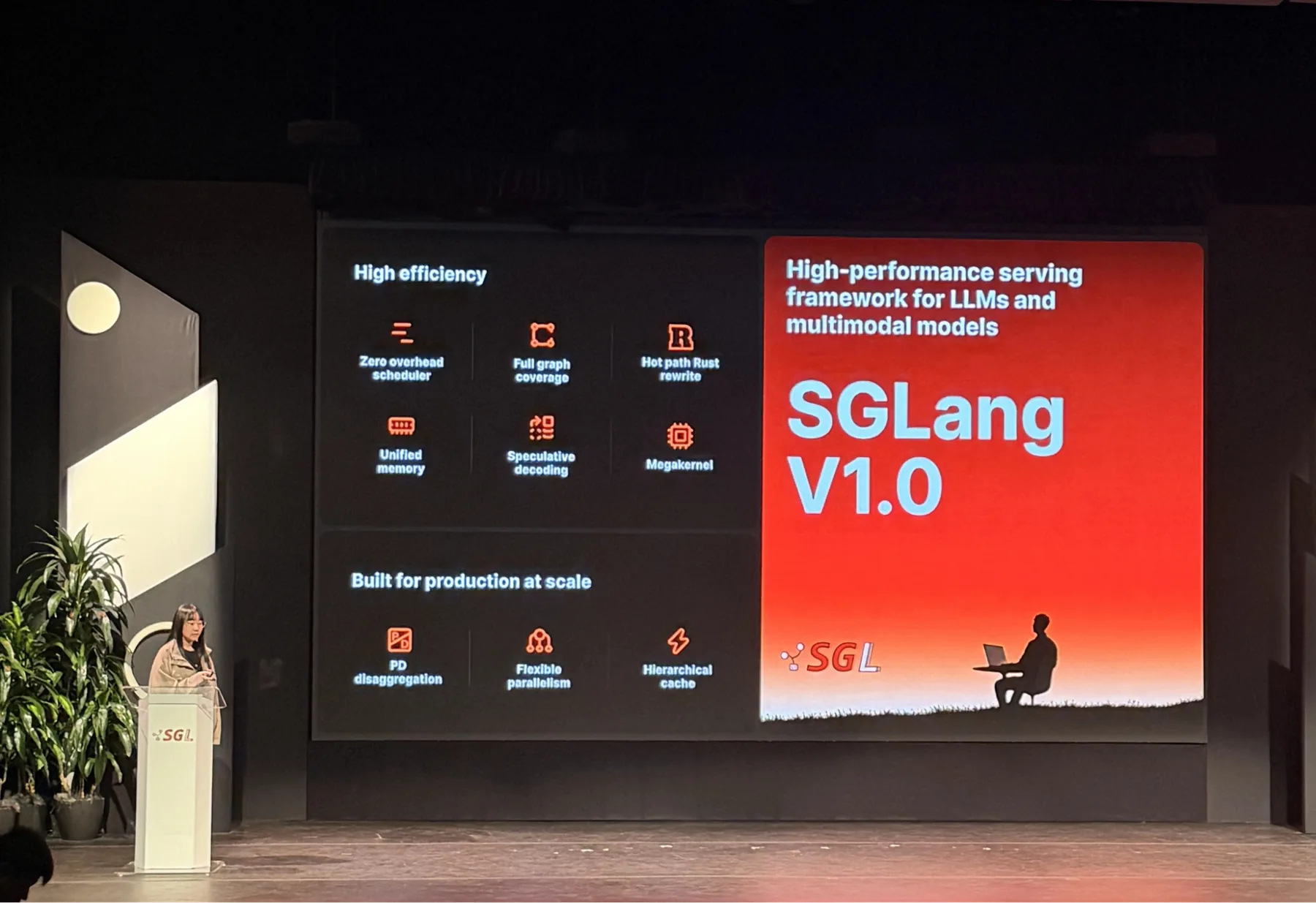
However, v1.0 has not yet been released. As of Nov. 18 Japan time, the release tracker was "Open," and many of the "Required" items that must be finished before release were "In progress." The checks that start after the release branch is cut had not yet begun. The tracker says the release schedule will be posted once it is set.
At the keynote, the team also said its way of developing the software has changed. According to LMSYS Org, AI agents already produce most of the change proposals (pull requests) merged into SGLang. Next, the team plans to work on AI tools that write code, review proposals and build tests.
Moving from 0.5 will require reviewing settings
The release tracker lists six changes that will require action from users moving from the 0.5 series.
The largest is the removal of "sgl-model-gateway," the component that distributes user requests across multiple servers. It is replaced by "sgl-router," written in the Rust language, and the component shipped in SGLang's Docker images (prebuilt packages for deployment) also changes to sgl-router. Features available only in sgl-model-gateway are not yet available in sgl-router.
Settings that previously produced a warning and were adjusted automatically will now stop with an error. Requests containing invalid values will also be rejected at the entry point. Administrative operations that change or inspect server state, such as updating model weights or managing caches, will require a dedicated key (--admin-api-key) and can no longer be used with the regular API key. Settings already deprecated in the 0.5 series will also be removed.
The upgrade guide had not been published as of the release tracker's latest state. Four points remain undecided, including whether to keep two widely used deprecated settings and the package name for sgl-router.
Meta uses it for products serving billions; 332 organizations
According to the project, the number of organizations using SGLang grew over the past year from a handful of early adopters to 332. In its consortium announcement, LMSYS Org named Meta, Microsoft, Google, Amazon, Thinking Machines Lab, Cloudflare, Reflection and Modal as companies using it.
At Meta, SGLang powers inference for products serving billions of users. A Meta engineer on stage at the summit said the company uses it for "Muse App," "Muse Code," the Meta family of apps and image and video workloads, running across NVIDIA and AMD GPUs, Google TPUs and Meta's own chip, "MTIA." According to LMSYS Org, Meta reported "more than 2× GPU savings" after moving from its prior inference solutions. It did not give specific numbers of machines or costs.
Teams from Modal, Cloudflare, LinkedIn, Fireworks, Baseten and others also shared lessons from running it in production.
There are also examples of moving away from SGLang. Elon Musk, who leads SpaceXSI (SpaceX Super Intelligence), posted on X on Nov. 10 that the company had dropped SGLang, which it had used for inference, and rewritten the system from scratch.
Miles v0.2 released, chipmakers broaden support
At the summit, the team also released v0.2 of "Miles," a system that uses SGLang to refine AI models through reinforcement learning (training that refines a model according to the quality of its answers). It runs on NVIDIA and AMD GPUs and Google TPUs, with support for Amazon's AI chip "AWS Trainium" coming soon. In addition to text, it can now handle reinforcement learning for images, video and audio.
Chipmakers also showed support. NVIDIA announced that SGLang now powers the certified versions of "NVIDIA NIM," its components for enterprise inference. Intel and RadixArk announced a collaboration to optimize SGLang for Intel chips. "SGLang-Neuron" v0.1.0 for Trainium, co-developed by RadixArk and Amazon's Annapurna Labs, was also released in public preview.
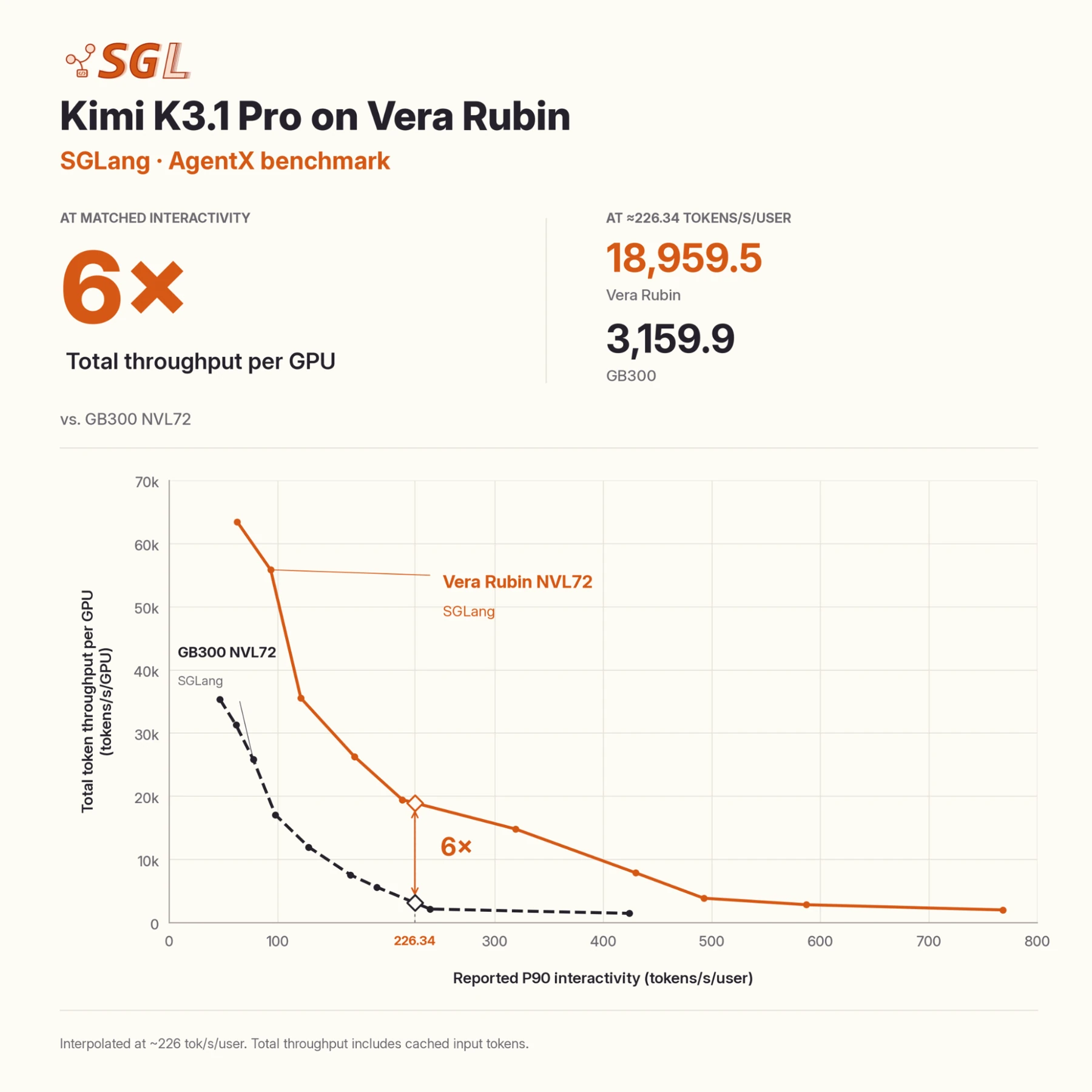
LMSYS Org's blog, in the section covering NVIDIA's talk, included a chart of results using the company's next-generation "Vera Rubin." On the agent benchmark "AgentX," running Moonshot AI's Kimi K3.1 Pro with SGLang and NVIDIA Dynamo, total throughput per GPU at matched per-user response speed was up to 6 times that of "GB300 NVL72," it said. The throughput includes cached input tokens. These are figures shown in SGLang's chart, and no third-party verification has been confirmed.
The keynote also covered vulnerabilities reported by Cloudflare and NEAR AI and the fixes they prompted. SGLang's developers called for partners to help with security review.
More than 2,000 attendees, over 90 talks
According to the project, more than 2,000 developers, researchers and others attended the summit. It held more than 90 technical talks and six hands-on workshops. Speakers on the main stage included Intel CEO Lip-Bu Tan, OpenAI's Lilian Weng, Thinking Machines Lab CTO Soumith Chintala and Perplexity CEO Aravind Srinivas.
Talk recordings and slides will be available soon, the organizers said.


