
Two systems that choose a model for each request
U.S.-based AI model routing service OpenRouter on Nov. 6 (Nov. 7 Japan time) released new versions of its systems (routers) that automatically choose which model to use based on the content of a request. It rebuilt "Auto Router," used for answering questions and AI agents (systems in which AI carries out work on its own) in general, and added "Auto Code" for programming agents.
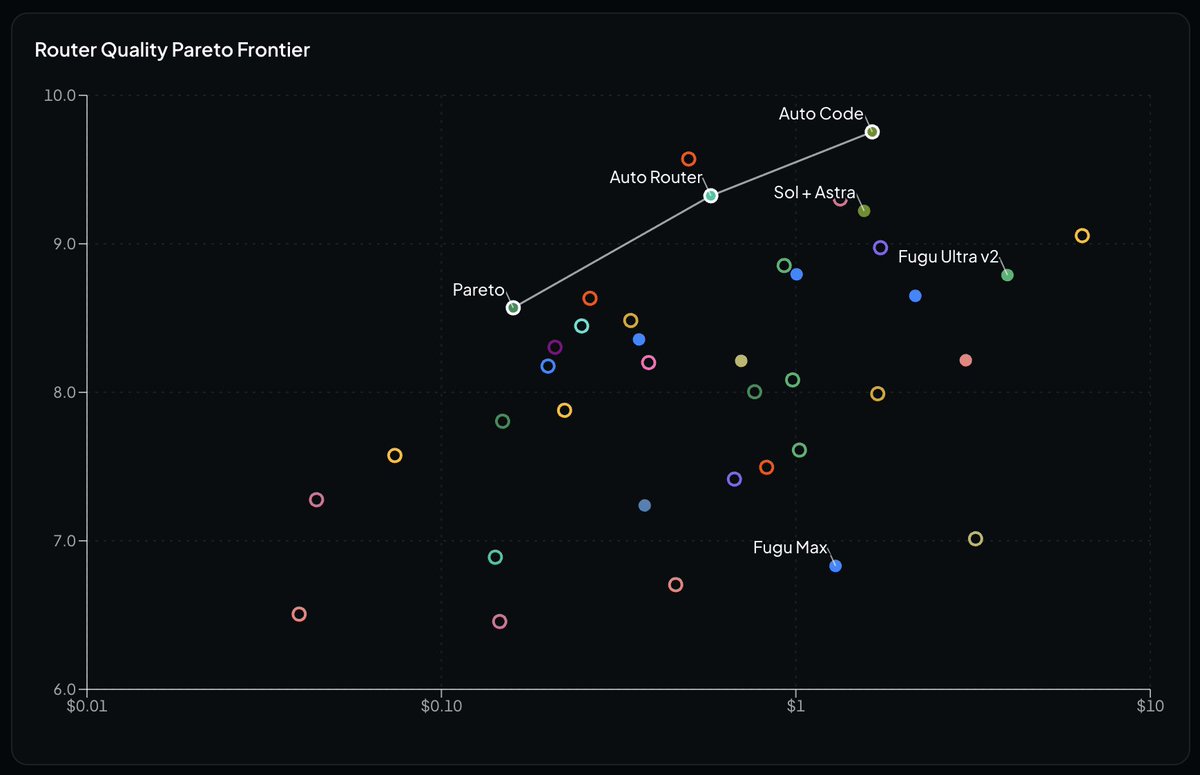
Introducing our next generation of model routers: Auto Router for general q&a + agents. Auto Code for coding agents. Auto Code benchmarks similar to Opus 5.5 while costing 74% less, they have a p90 latency of just 0.65s, and we show how routing decisions are made per request.
More than 600 models on OpenRouter are candidates. After narrowing the candidates based on the user's restrictions and data retention conditions, a fast decision model evaluates the request on 11 dimensions, including the type of task, its difficulty, whether speed is needed and whether images need to be read. It then decides on the model and the depth of reasoning based on current pricing, whether reusable content (cache) is available and the evaluation results. It also shows the reason for its choice for each request.
Auto Router started in 2023 and handles requests totaling more than 2.5 trillion tokens (units of text) from more than 100,000 users a month, the company says.
Opus 5.5-level at 74% less is the company's own evaluation
OpenRouter said Auto Code matched the scores of Anthropic's "Claude Opus 5.5" on five benchmarks covering programming and tool calling, among others, at 74% lower cost per task. The announcement, however, does not give Opus 5.5's individual scores, how the five results were averaged or what settings Opus 5.5 was run with. It also does not show any third-party verification.
The "0.65 seconds" is the time it takes for the router to choose which model to use. In the company's measurements, the value at the slowest 10% position (p90) fell from 1.96 seconds in the old version to 0.65 seconds, it said. It does not include the time for the selected model to finish writing its answer. The number of measurements and the period were not given.
In comparisons using a preview version, it said malformed tool calls fell to a quarter and the number of agent responses cut off midway was halved compared with the old version. The company also wrote that no router on the market beats the top single model on every point of cost and quality, acknowledging that Auto Router is no exception.
Scores up from the old version
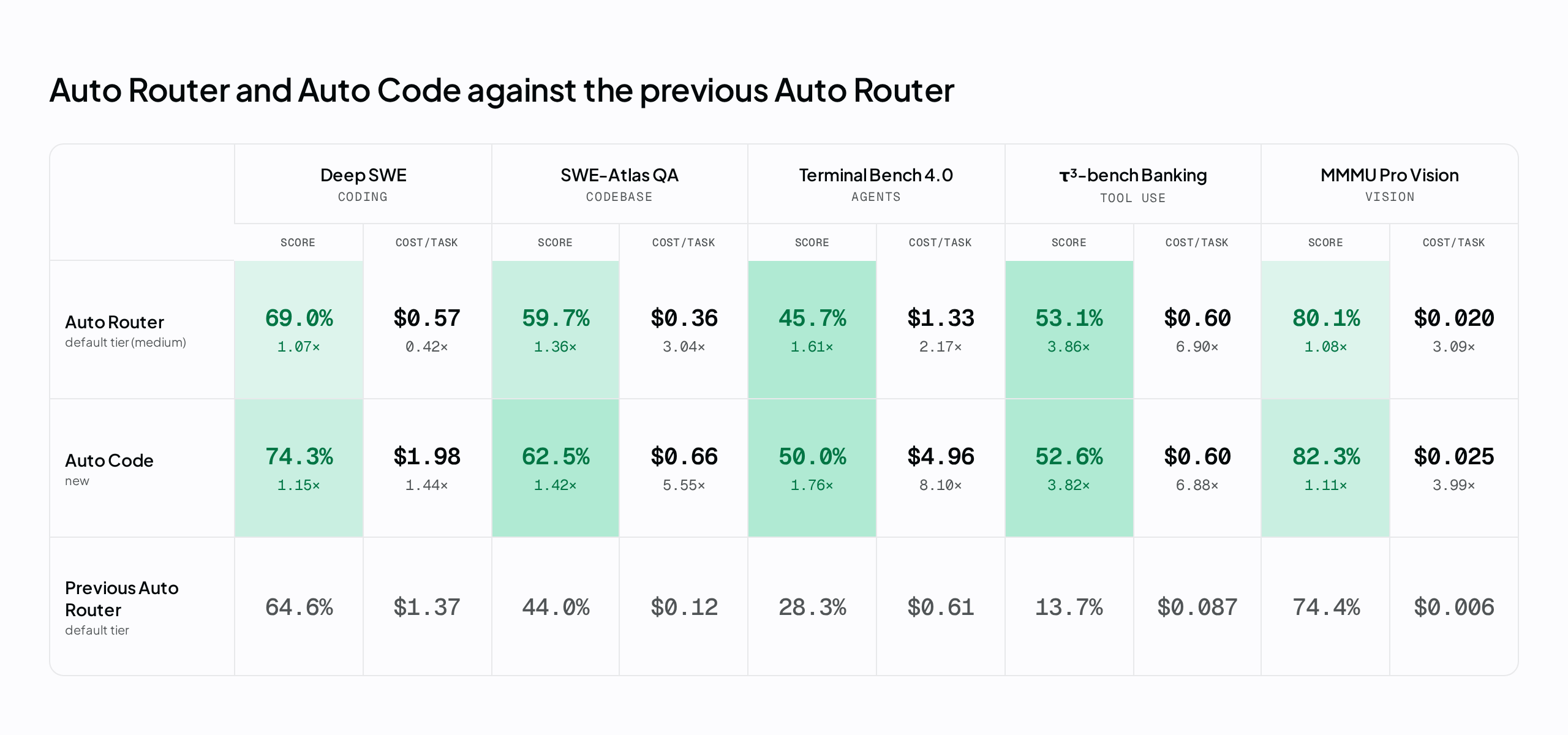
The company has published a table comparing the routers with the old version. Comparing default settings, the new Auto Router outperformed the old version on all five benchmarks. On "τ³-bench Banking," which measures tool use in a banking scenario, the score rose from 13.7% to 53.1%. Auto Code scored 74.3% on the programming benchmark "Deep SWE," above the old version's 64.6%. On τ³-bench Banking, however, Auto Code scored 52.6%, below Auto Router's 53.1%.
- Auto Router
- Auto Code
- Old Auto Router
Cost per task up to 8 times the old version
Cost per task, on the other hand, rose on many benchmarks. Auto Code was more expensive than the old version on all five, and on "Terminal Bench 4.0," which measures an agent's ability to work in a command-line screen, it rose 8.10 times from the old version's $0.61 to $4.96. Auto Router was also 2.17 to 6.90 times the old version on four benchmarks, the exception being Deep SWE, where it fell from $1.37 to $0.57. On "MMMU Pro Vision," which involves interpreting images, Auto Router cost $0.020 and Auto Code $0.025, versus $0.006 for the old version.
OpenRouter acknowledges that the new Auto Router's default setting costs more per task than the old version. It explains that to make more kinds of models available, it is returning to pricing closer to Auto from a few months ago. It says Auto Code also starts at a higher cost tier.
- Auto Router
- Auto Code
- Old Auto Router
Auto Router's cost tiers do not apply to Auto Code
There is no additional charge for using the routers; users pay the regular price of the selected model. Which model was used is recorded in the response.
Auto Router lets users choose a cost tier from "low," "medium" and "high." Low prioritizes lower estimated cost and brings costs close to the old version, the company says. If not specified, it runs at the default setting, and the Auto Router figures in the announcement's table are for medium. Scores and costs at low are not included in the announcement's table.
Auto Code ignores the cost tier specified for Auto Router and runs on its own programming-specific tiers. To run it on the general tiers, users must specify them separately under "Jev Router," which uses TypeSafe's decision model "Jev." The documentation says the cost tier is a routing preference and does not guarantee a specific model, score or cap on per-request pricing.
Users can restrict the models that may be used, and price caps they set also apply to the selected model. The routers run only in the global processing region, and Auto Code does not support settings that keep processing within Europe.
OpenAI's GPT-6.1 Sol gets 30% of routed requests
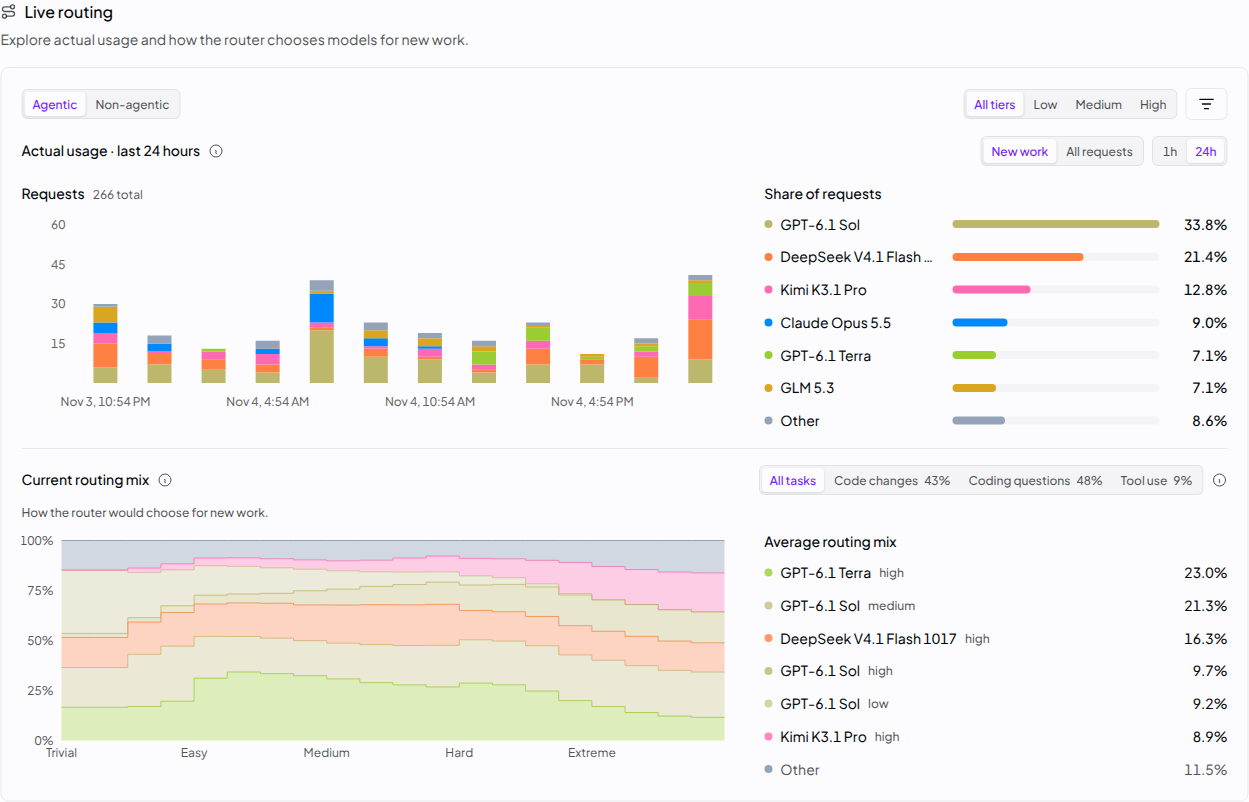
According to Auto Router's routing record shown in OpenRouter's announcement, of 266 new agent requests received in the 24 hours from Nov. 3 to 4, 33.8% went to OpenAI's "GPT-6.1 Sol." China's DeepSeek "DeepSeek V4.1 Flash" followed with 21.4%, China's Moonshot AI "Kimi K3.1 Pro" with 12.8% and Claude Opus 5.5 with 9.0%. These are counts for one day and may vary over time.
Routing volume growing
OpenRouter is a routing service that makes AI models from various companies available through a single gateway. According to The New York Times, it raised $113 million in May in a round led by Alphabet's CapitalG, valuing it at about $1.3 billion. Its volume at the time was 25 trillion tokens a week, up from 5 trillion tokens six months earlier.
Crypto Briefing reported on Nov. 2 that the company's annualized volume, calculated as 52 times its weekly volume, had exceeded 10 quadrillion tokens. Systems that automatically choose the model shift the decision of which model to use from the user to the routing service. The focus will be on how third parties assess the cost and score figures.


