ChatGPT and Codex for mechanical and electrical design
OpenAI on Nov. 3 (Nov. 4 Japan time) disclosed efforts to use its chat AI "ChatGPT" and AI coding tool "Codex" for mechanical design, electrical design and simulation. It described how its internal hardware teams use them, an attempt to have its top model "GPT-6 Astra" design a device, and collaborations with outside companies including Mazda. No new products, features or pricing were announced; the disclosure shows progress to date.
ChatGPT and Codex are helping engineers build for the physical world. We're sharing our progress across mechanical design, electrical engineering, and simulation—from helping our hardware teams iterate faster to testing new workflows with industry collaborators.
The company's hardware and computing infrastructure teams use Codex and ChatGPT in developing robots and data center equipment to create and revise CAD (computer-aided design) models, produce manufacturing drawings, set up simulations and review designs. According to OpenAI, these teams' AI usage, counted in tokens (units of text that AI processes), has grown 23-fold since February. Blockchain.News pointed out that the figure reflects growth in usage and does not indicate a 23-fold increase in productivity.
Prototype designed in under a week; production prep needed human review
OpenAI had GPT-6 Astra design a device under the condition that humans would not directly edit the design. The device is for talking with Codex by voice. Astra determined the required functions, designed the enclosure and the internal structure that holds the parts, and selected electronic components and laid out and routed the circuit board to fit in the enclosure. Astra also produced the user interface design, the firmware (embedded software that runs the device) and the software for linking with Codex. For its look, it drew on OpenAI's collaboration with Work Louder, with which it built "Codex Micro," an input device for Codex released in July for $230, as well as on games and toys.
According to the company, two employees designed the device in less than a week alongside their regular work, and a contract manufacturer produced a small batch of prototypes in less than a month. Preparing for mass production, however, required repeated reviews and revisions. Astra could not consistently account for manufacturing constraints, tolerances (permissible ranges for dimensions) and assembly conditions, the company said. OpenAI listed the gap between producing a complete design and finishing it in a form that can be mass-produced as an area for improvement in future models.
Internal model scores 0.875 on CAD benchmark, public model 0.59
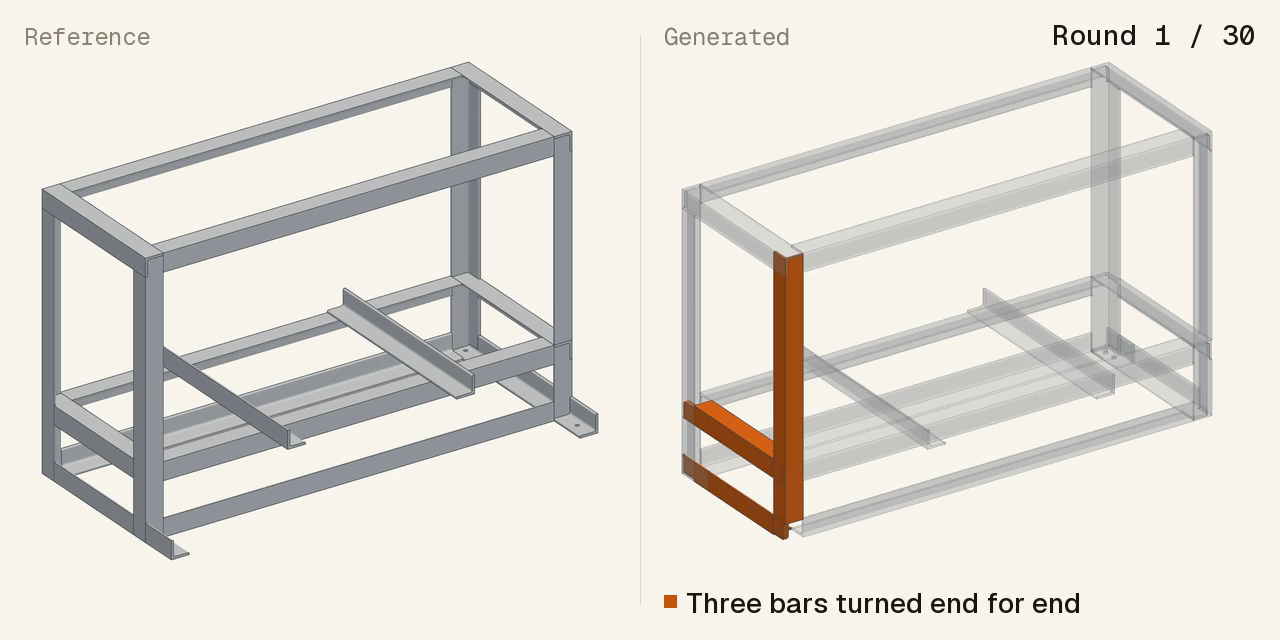
OpenAI also presented results on "BenchCAD 2.0," a benchmark that measures the ability to reconstruct parts and assemblies in 3D and to read wiring from photos of circuit boards. An unnamed new internal model whose release timing has not been disclosed averaged 0.875 (out of 1), above 0.594 for GPT-6 Astra at its highest reasoning setting.
BenchCAD 2.0, released on Oct. 12, consists of 100 problems in six categories, including building parts and assemblies from drawings, reconstructing parts from images and reading circuit board wiring. It does not use AI grading and checks answers against the correct ones. In the published table, at the highest reasoning settings, GPT-6 Astra scored 0.59 and Anthropic's Claude Opus 5.5 scored 0.57, a small difference. The cost per problem was $11 for Astra versus $28 for Opus 5.5, and the median time taken was 62 minutes versus 3.7 hours. The table does not include models from other companies such as Google or xAI. The operator noted that it received API usage credits from Anthropic and OpenAI.
The 0.875 for the new internal model is a figure OpenAI gave in its own announcement and does not appear in BenchCAD's public table.
Research on vehicle aerodynamic design with Mazda
OpenAI is collaborating with Mazda on research. OpenAI's research team and its unit that sends engineers to companies to support adoption will work with Mazda's aerodynamics and crash safety engineers. They will use airflow and structural simulations to explore vehicle design options while balancing performance, design and cost. According to Unite.AI, Astra generates options for the shape of the vehicle's front end and runs airflow simulations to narrow them down to shapes that reduce drag. Mazda engineers explained that testing dozens of options reveals which features affect aerodynamics. OpenAI said it will publish progress in the coming months.
OpenAI is expanding the scope of its collaboration with U.S. racing team Chip Ganassi Racing. They will test 3D scanning existing parts and creating editable CAD models and 2D manufacturing drawings from them. This is said to help with parts whose original design data no longer exists. The team's engineers are checking the accuracy of the results and whether they can be manufactured. The two companies partnered in February 2025, and in the first year worked on analyzing car sensor, race and pit stop data.
OpenAI is inviting mechanical, electrical, mechatronics and manufacturing engineers, as well as design, simulation and manufacturing software companies, to join as collaborators.


