
Five features, including automatic review of actions, added to the Agents API
OpenAI said on Oct. 30 (Oct. 31 Japan time) that it had added five features that week to its "Agents API," which lets companies and developers build AI agents (systems in which AI works out steps on its own and carries out work) into their own services. Centered on "Auto Review," in which a separate AI judges whether an action is dangerous before the agent runs a command, the additions also include running the summarization of context mid-task asynchronously, an experimental feature called "Time awareness" that tells the AI how much time has passed, swapping tools during a task, and automatic caching of system prompts (the AI's base instructions). OpenAI's Steven Coffey, who works on the Agents API, posted about it on X. Corresponding settings were also added to the company's Python software development kit (SDK) released on Oct. 31.
The Agents API is a service that offers outside developers the system OpenAI uses for its coding assistant "Codex." OpenAI operates the calls to AI models, the execution of tools and the carryover of context in long tasks, while developers specify the agent's instructions, tools and work environment. It launched as a public beta on Sept. 10, and there is no additional charge for the Agents API itself; users pay for the tokens and tools they use.
A separate AI judges actions awaiting approval
Auto Review is a feature in which a separate AI, instead of a person, reviews actions for which an agent seeks human approval. It has been used in Codex under the name "Auto-review." According to OpenAI's safety research blog, in Codex, actions inside the isolated work environment (sandbox) proceed without approval, and only actions that go outside it are sent for review. The reviewing AI decides whether to approve or reject based on the user's intent, the environment, safety policies and the size of the impact, and returns a reason when it rejects. It uses "GPT-5.4 Thinking" for the review.
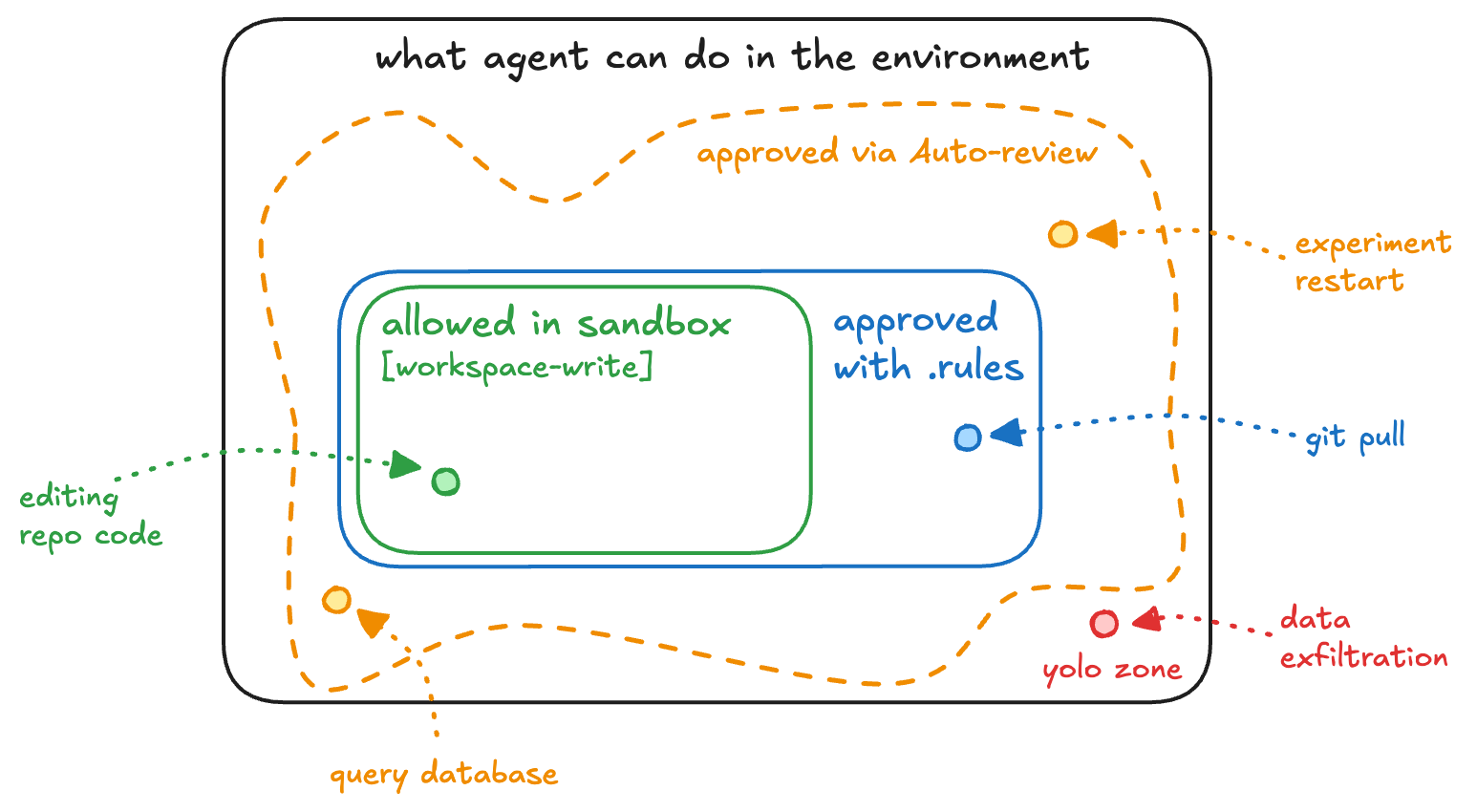
In OpenAI's internal evaluation, it correctly rejected 90.3% of overreaching actions that went beyond the user's instructions, and detected 99.3% of attacks that manipulate AI with instructions hidden in external text (prompt injection). The number of times work stopped for human approval fell to about one-200th of that with manual approval, the company said. On the other hand, that means about 10% of overreaching actions were missed, and OpenAI also says it is not a mechanism that guarantees safety.
OpenAI gave a breakdown of 10,000 actions run in Codex as an example. Of these, 9,280 proceeded inside the sandbox without approval, and Auto-review reviewed the remaining 720. It approved 713 of them and rejected 7. Of the 7 rejected, in 4 cases the agent switched to a safer method and continued working, and in 3 cases it stopped to ask the user for a decision.
- Run inside sandbox
- Approved by Auto-review
- Rejected by Auto-review
Disabled by default in the Agents API
Auto Review in the Agents API is disabled by default, and developers enable it for each session (a single unit of work). The API specification says that when enabled, it automatically reviews the covered actions and does not send them for manual human approval. However, it does not provide a list of which actions are subject to review.
Since Oct. 6, Codex has made use of the reviewing AI free when used with a ChatGPT account and has not counted it toward plan usage. OpenAI has not said whether it will charge for use of the reviewing AI in the Agents API.
Summarization runs in the background for long tasks
The other four features are designed for work lasting many hours. When the context the AI can handle at once nears its limit, "compaction," which summarizes the work so far, now runs in the background without halting the work. This setting is enabled by default. The API specification cautions that token usage may increase, and OpenAI has not given figures on the impact on speed or cost.
Time awareness is an experimental feature that periodically tells the AI the current time, and it is disabled by default. AICoder, an information site for developers, gave the example of having an agent wrap up a fix within 10 minutes. It is also now possible to swap the tools available to an agent mid-task.
System prompts are now cached automatically in every session. According to OpenAI's pricing explanation, cached input costs one-tenth of the regular input price, and one-20th for GPT-6.1 Sol and GPT-6.1 Terra. The more agents a company runs with the same instructions, the more cost savings it can expect.
Public beta in September, with features added almost weekly
The Agents API is still in public beta, and OpenAI says it aims for general availability based on user feedback. According to secondary sources, data is stored only in the United States, and it does not support "zero data retention" agreements under which inputs are not stored.
The previous week, on Oct. 23 (Oct. 24 Japan time), OpenAI also added "Automations," which launches agents at set times. Users can choose recurring runs, such as daily or hourly, or a one-time run.
Anthropic and Cursor also offer similar platforms
Companies are competing to build platforms for running agents. Anthropic released "Claude Managed Agents" on April 8. In addition to model usage fees, it charges 8 cents per hour of agent runtime. Developers can set rules on whether tools may be run without human permission.
AI coding tool maker Cursor on Oct. 26 (Oct. 27 Japan time) made generally available its "Agent SDK," which lets agents be defined as code. Google is also preparing an agent management screen in its developer service "Google AI Studio," an X account that tracks new features reported on Oct. 25.


