
Weights released 12 days after announcement
Chinese AI company Moonshot AI on Nov. 4 (Nov. 5 Japan time) released the weights (trained parameters) of its large model "Kimi K3.1 Pro" on the AI sharing site Hugging Face. When it began offering the model via its API and other channels on Oct. 23 (Oct. 24 Japan time), it said the weights would come "by Nov. 4," and it kept to that schedule. With the weights available, companies can run the model on their own servers or do additional training on their own data.
Releasing the model weights of Kimi K3.1 Pro. We'll keep advancing open intelligence.
According to the model card, it has 2.8 trillion total parameters, 104 billion of which are used to process each token, and a context window of about 1 million tokens, the same as the specifications at the announcement. The weights are distributed in "MXFP4" format, which compresses values to 4 bits, and the model was trained with that compression in mind. The company also disclosed that it replaced part of the attention mechanism of the previous model, "Kimi K3," with a method developed by China's DeepSeek. It points to vLLM, SGLang and TokenSpeed as software to run it, but gives no guidance on the number of GPUs or the memory required.
According to Beri.net, the files are split into 96 parts totaling about 1.56 terabytes. For its previous model, K3, Moonshot also released the weights 11 days after the July announcement.
- "Kimi K3.1" name appears in a proposed change to inference software sglangLeak
- Kimi K3.1 Pro officially announced, with weights promised by Nov. 4Official
- Repository for the weights created on Hugging FaceReport
- Weights releasedOfficial
Top score for open models rises from 32 to 46
On the overall index (version 5, published Oct. 27) of Artificial Analysis, a U.S. firm that compares AI models under the same conditions, Kimi K3.1 Pro scored 46. The highest scores among models whose weights had been released until now were the 32 of DeepSeek's "V4.1 Flash 1017" and China's Zhipu's "GLM-5.3," and K3.1 Pro beats them by 14 points. On the other hand, it trails top-ranked Anthropic's "Claude Opus 5.5" at 58 and OpenAI's "GPT-6 Astra" at 57 by 12 and 11 points, respectively. As of Nov. 5, Artificial Analysis' model page treats K3.1 Pro as a model with released weights.
The score of 55 that Artificial Analysis published at the time of the announcement was based on the previous version of the index and cannot be compared with the 46 on version 5.
Lags in response speed; scores on legal and tax evaluations decline
In Artificial Analysis' measurements, output on Moonshot's API runs at 32 tokens per second, and it takes 146 seconds for the first answer to appear. It took 37.1 minutes to solve one task of the index's tests, against a median of 13.7 minutes for the models compared.
According to Beri.net, in evaluations by U.S.-based Vals, K3.1 Pro's overall score was 62.52%, up from K3's 52.96%. However, the evaluation of legal research fell from K3's 46.15% to 37.50%, and the tax evaluation fell from 33.37% to 24.87%.
Separate agreement required for large providers
The license adds Moonshot's own conditions to text close to the MIT license, which permits copying, modification and redistribution. Companies that run a business offering the model to others and whose revenue, including affiliates, exceeds $20 million over 12 consecutive months must sign a separate agreement with Moonshot before using it commercially. Commercial products or services with more than 100 million monthly users or monthly revenue above $20 million must prominently display "Kimi K3.1-Pro" on screen.
Internal-only use, and use through Moonshot's products or inference providers it has approved, are exempt from these two conditions. Internal use is defined as use that does not offer the model, its outputs or its capabilities to outside parties.
For major cloud and API providers to offer K3.1 Pro themselves, an agreement with Moonshot is a prerequisite. According to Beri.net, Together AI listed pricing of $2 for input and $10 for output (per 1 million tokens) on its price list, but as of Nov. 4 its model page still said "coming soon." There are also no inference providers running this model on Hugging Face yet. OpenRouter has offered it since Oct. 23 (Oct. 24 Japan time) at the same $2 for input and $10 for output as Moonshot.
Released version has reduced cyberattack capabilities
In a technical blog post, Moonshot explained that for the version with released weights, it removed cyber-related data from both mid-stage training and reinforcement learning. General programming tasks were kept. On the company's internal evaluation, xdev-bench-hard, a prototype model without this measure solved 90.5% of problems, while the final K3.1 Pro solved 81.0%. The company said it plans to gradually raise the cyber capabilities of the weights it releases.
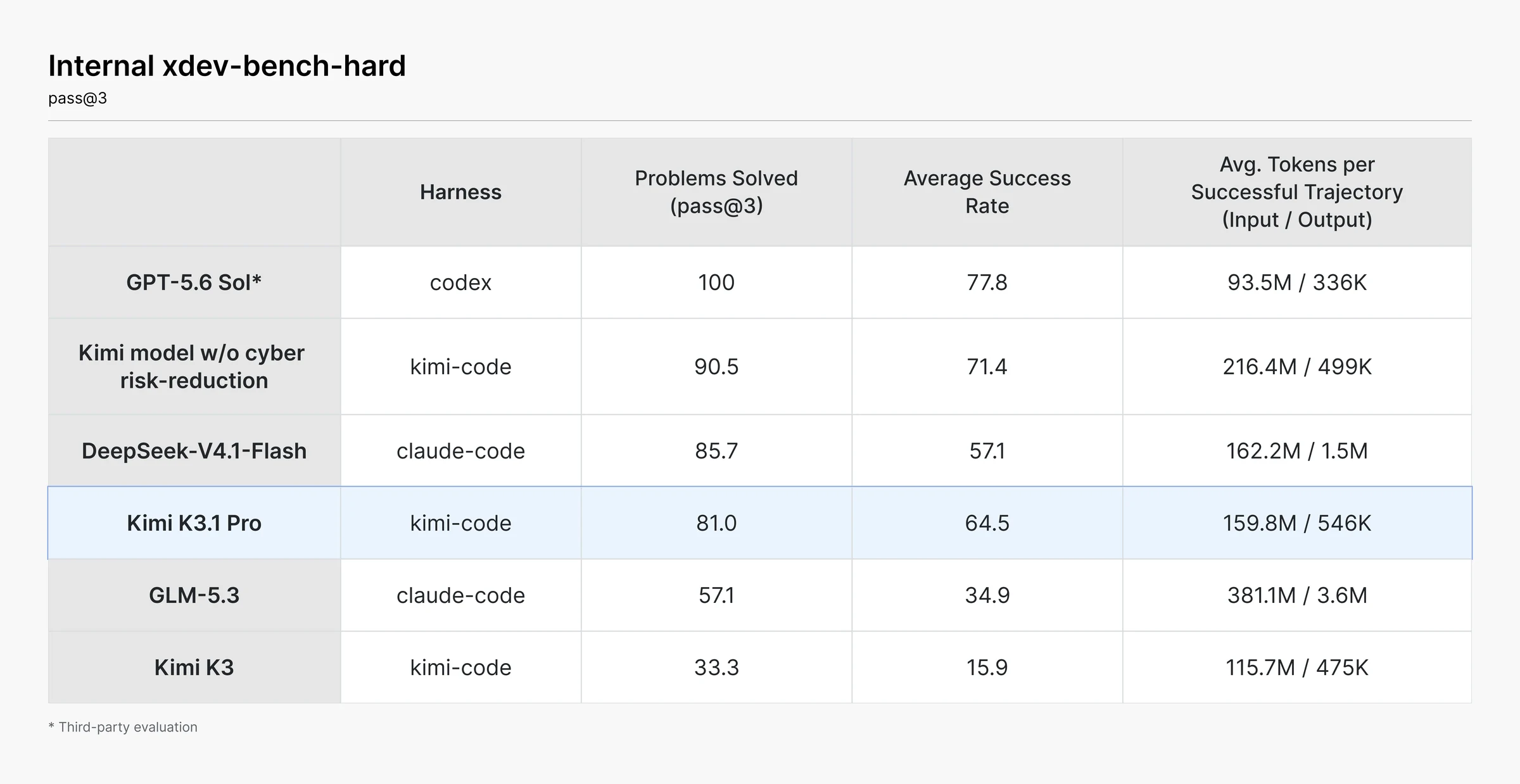
On ExploitBench, which measures the ability to exploit vulnerabilities, K3.1 Pro also scored 74.7, below Claude Opus 5.5's 91.0 and GPT-6 Astra's 100. All of these figures were presented by Moonshot in its model card and were compiled by the company itself.
Valuation of $35 billion
Beijing-based Moonshot has been rapidly raising its valuation through fundraising. China's Yicai Global reported on July 30, citing people familiar with the matter, that the company had raised more than $3.5 billion at a valuation of $35 billion. In May, Bloomberg reported that it was valued at about $20 billion in a roughly $2 billion round led by the investment arm of China's Meituan.
Among Chinese companies, StepFun also released the weights of its large model "Step 5 Preview" in October.


