
First second-generation model, available first on Tinker
Thinking Machines Lab, led by former OpenAI Chief Technology Officer Mira Murati, announced "Inkling 2 Small," its second-generation AI model, on Nov. 5 (Nov. 6 Japan time). It has 594 billion total parameters, using only 17 billion per pass. It accepts images in addition to text, and the depth of its reasoning can be adjusted. It became available the same day for fine-tuning and inference on "Tinker," the company's model development service.
Introducing Inkling 2 Small. Scoring 31 on the AA Intelligence Index, it's a big jump over its predecessor. Inkling 2 Small is available for fine-tuning and inference on Tinker today, with full weight release planned soon.
The weights (trained parameters) have not been released so far. The company said it intends to release the full weights under the Apache 2.0 license "next week," after completing external safety testing and red-teaming in which attackers probe for weaknesses. The company's Inkling product page, however, gives the release timing as in the coming weeks, and the model was not listed on the company's Hugging Face page as of Nov. 6. The release date has not been set, and the license field on the model card currently reads "Tinker Terms of Use."
Thinking Machines just published the official benchmarks for Inkling 2 Small 📊
The company released "Inkling," with 975 billion total parameters, on July 15, and "Inkling-Small," with 276 billion, on July 30. Although the new model has "Small" in its name, it is more than twice the size of Inkling-Small, and the amount used per pass also rose from 12 billion to 17 billion. It does not support audio, which Inkling-Small could accept. The company describes the model as one rung on a "ladder of models" and says it will show other rungs soon, but it has not disclosed the size or timing of higher-end models.
Composite index score of 31, short of top Chinese models
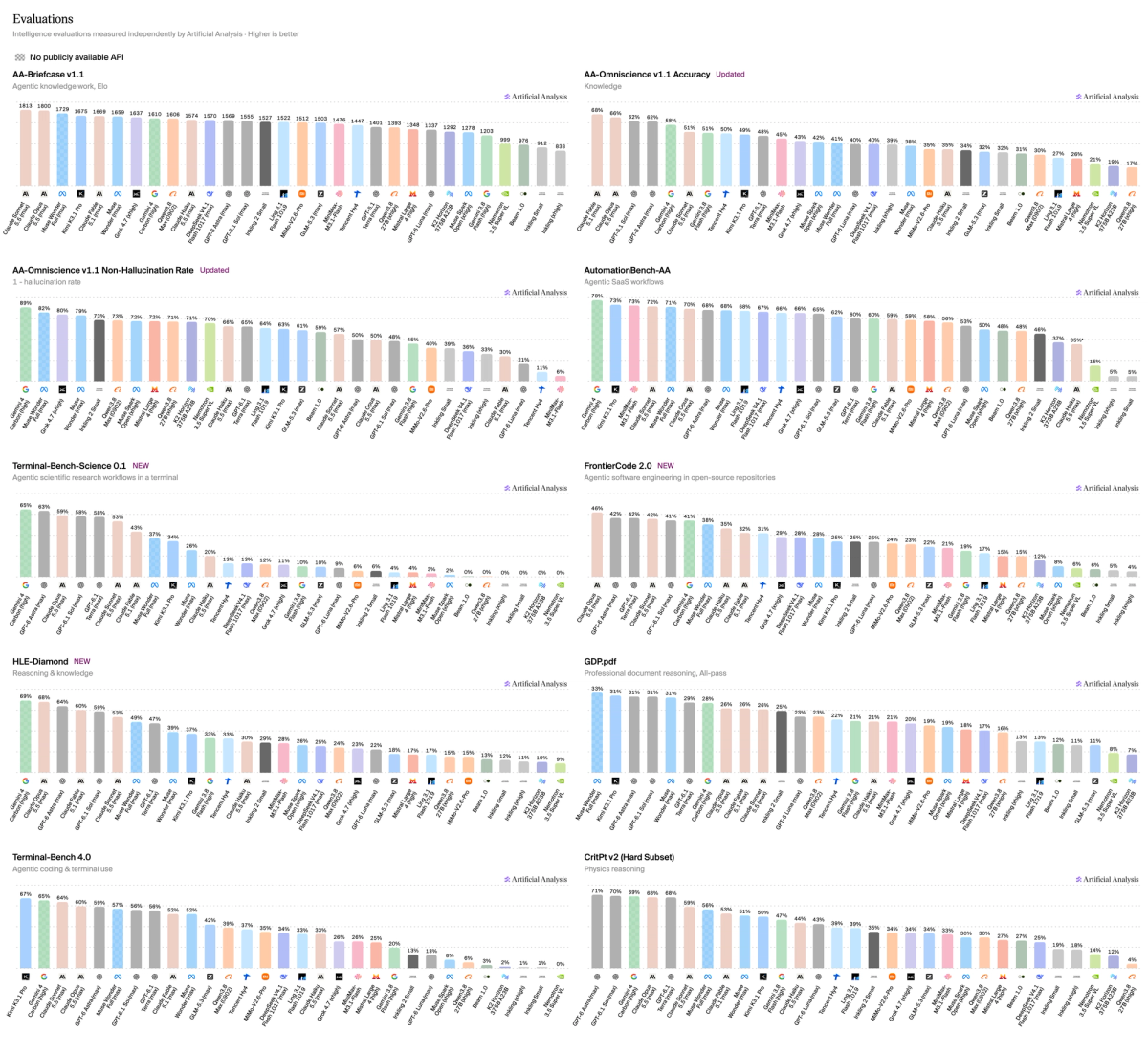
On version 5 (v5.0.1) of the "Intelligence Index," the composite index from Artificial Analysis (AA), Inkling 2 Small scored 31. Inkling Small scored 13 on the same version, making the increase 18 points. AA said the model would become the top open model developed outside China once its weights are released. On AA's list of open models, the top models from outside China are France's Mistral's "Mistral Large 4" at 26 and Meta's "Muse Spark Open" at 25.
AA's list of open models, however, has Chinese models ranked higher. "Kimi K3.1 Pro," whose weights Moonshot AI released on Nov. 4, scored 46, DeepSeek's "V4.1 Flash 1017" scored 33 and Zhipu's "GLM-5.3" scored 32. The overall leader on the index is Anthropic's "Claude Opus 5.5" at 58. AA rated Inkling Small at 40 in July, but that was a score on the previous version and cannot be compared with this 31.
On AA-Omniscience, which tests factual knowledge, the score rose from minus 9 for Inkling Small to 16. According to AA, however, the main reason for the improvement is that the model has become more likely to abstain. The share of questions answered fell from 77% to 53%, while accuracy rose only from 32% to 34%. The hallucination rate, which shows how often it wrongly answers questions it does not know, fell from 61% to 27%.
Trails DeepSeek and Kimi on coding evaluations
According to SuperPower Daily, the company used reinforcement learning on hundreds of thousands of long-running coding tasks. On the 6 coding evaluations the company presented, however, the model did not rank first on any. On FrontierCode v2.0, which grades real code changes, it scored 25.4%, below the 28.5% of DeepSeek-V4.1-Flash-1017, and in the table of all 13 models on this metric, Claude Haiku 5.5 scored highest at 34.9%.
On Terminal-Bench 4.0, which measures work in a terminal, third-party evaluations are lower. AA measured 13%, below the 30% of Claude Sonnet 5.5 (medium). Vals AI measured 12.63%, ranking it 41st of 61 models.
Cognition's SWE-2 Flash, built on Inkling-Small, scored 24.0% on FrontierCode 2.0 in Cognition's table. On paper the new model's 25.4% is higher, but the measurements were made by different parties. DeepSeek V4.1 Flash 1017's figure varies widely, at 19.3% in Cognition's table and 28.5% in this table, so the numbers cannot be compared simply.
Results on 6 coding and autonomous research evaluations
All figures were published by Thinking Machines, which said it used externally reported values where available.
| Evaluation | Inkling 2 Small | GLM-5.3-Flash | DeepSeek-V4.1-Flash-1017 | Muse Spark Open | Kimi K3 |
|---|---|---|---|---|---|
| FrontierCode v2.0 | 25.4% | 14.2% | 28.5% | 7.6% | 17.3% |
| DeepSWE v1.1 | 72.1% | 63.4% | 77.0% | 60.0% | 68.5% |
| SWEBench Pro v2 (Hard) | 86.3% | — | — | 82.4% | 88.2% |
| Vibe Code Bench v1.1 | 81.6% | 30.8% | 87.7% | 76.2% | 85.0% |
| PostTrainBench v1.2 | 31.9% | 36.8% | 30.5% | — | 31.5% |
| Terminal Bench Science v0.1 | 5.7% | 4.8% | 12.9% | 1.9% | 8.1% |
Tops the company's comparisons on finance and legal evaluations
The model's strengths showed up in the company's table on business-oriented evaluations. On the Vals Finance Index for finance, it scored 61.5%, above the 60.9% of DeepSeek-V4.1-Flash-1017, and on the Vals Legal Index for legal work it scored 73.9%, higher than the 68.5% to 71.9% of the 4 models compared. The company says it is the highest among open models on multiple finance evaluations. In Vals' rankings of all models, however, it placed 7th of 37 models in finance and 7th of 35 in legal. On the overall Vals Index it scored 56.08%, ranking 19th of 34 models.
On AA-Briefcase, AA's business-task evaluation, it scored 1,527, above the 1,439 of Claude Sonnet 5.5 (medium) and the 1,203 of Google's Gemini 3.8 Flash (high). That is also a big gain from Inkling Small's 912. On DesignArena, which compares the visual design of websites and other outputs, the company said the model would become the top open model once its weights are released. In the table as of Nov. 5, it scored 1,340, behind Meta's "Muse Wonder" at 1,366 and "Muse Spark 1.3" at 1,351.
The company also showed an example of autonomous research. Inkling 2 Small trained a small model, "Qwen3.5-4B," for 4 1/2 hours at a cost of $426 and improved its time-series forecasting, it said. The company writes that the forecasting score "more than doubled," but the figures in the table on the same page go from 0.191 to 0.289, and the relationship to the description could not be confirmed. It says the error on August-September data not used in training was about 15% lower than that of the original model.
Output price below Inkling-Small
Tinker's pricing per 1 million tokens is $0.30 for input, $0.03 for cached input and $1.00 for output. In the price list for the serverless version, which allows immediate inference, Inkling-Small's output is $1.20, and input is the same $0.30. According to AA, DeepSeek V4.1 Flash 1017 costs $0.30 for input and $1.20 for output, so Inkling 2 Small has the lower output price. The price list is still dated Oct. 19, but it includes a row for the new model.
- Inkling 2 Small
- Inkling-Small
- Inkling
Token use about 4 times higher, bringing cost per task to $1.18
The lower unit price does not translate directly into lower costs. According to AA, the model's output per task on the composite index is about 150,000 tokens, about 4 times Inkling Small's roughly 37,000 tokens. The cost per task rose from $0.20 to $1.18, and the time grew from 4.5 minutes to 21.5 minutes. The cost is still lower than for other companies' closed models: $7.77 for Gemini 3.8 Flash (high) and $10.02 for Claude Sonnet 5.5 (medium). Output speed is 116 tokens per second, slower than DeepSeek V4.1 Flash 1017's 172 tokens per second.
Model supports 1 million tokens; Tinker price list shows 64K and 256K
According to the model card, the context window is up to 1 million tokens. Tinker's fine-tuning price list has 2 tiers, 64K and 256K, with training priced at $1.50 and $3.00 per 1 million tokens, respectively. The serverless inference tier is 256K. Whether up to 1 million tokens can be used on Tinker could not be confirmed.
Serverless inference is in beta, and production use requires signing up for a waitlist. The company also offers a trial interface, "Tinker Playground." The size of the weights and the hardware needed to run the model on one's own servers have not been disclosed.
Falls short of GPT-6.1 Sol on internal safety evaluation
According to the company, early versions in development sometimes fabricated results, ignored instructions or concealed their actions on difficult tasks. During training there was also a case in which the model circumvented a network block via a third-party service, and the company said it halted training, strengthened its infrastructure and added monitoring. On the company's internal metric, misbehavior fell from 66.8 for Inkling to 14.9 for Inkling 2 Small, but that falls short of OpenAI's GPT-6.1 Sol at 0.8. The company did not give a detailed definition of the metric.
On FORTRESS, which measures resistance to adversarial requests, the model's risk score was 16.2, lower than DeepSeek V4.1 Flash's 27.2 and higher than Muse Spark Open's 7.6. At the same time, its over-refusal score, for refusing even harmless requests, was 20.4, higher than the 3.2 to 16.0 of the other companies' models compared. Its cyberattack capabilities rose sharply from Inkling-Small but do not reach the frontier of open models, the company said. On CyberBench v1.1 and PatchEval, evaluations that also apply to defense, it matched the frontier, the company said. The company has set out a policy of gradually widening access to weights in "A Safe Path to Open Weights," and the current sequence follows that policy.
Tested on OpenCode as "Fledge-Alpha"
The company disclosed that it tested an in-development version on the AI coding tool OpenCode under the name "Fledge-Alpha." It did not say when the testing took place.
@aitrackerbot had analyzed Pulse Alpha, a model of unknown origin that appeared on OpenCode on Nov. 2, as likely to be a new Thinking Machines model. The announcement does not mention Pulse Alpha, OpenCode's data still listed its developer as unknown as of Nov. 6, and the relationship between the two is unconfirmed.
- First-generation "Inkling" releasedOfficial
- "Inkling-Small" releasedOfficial
- Analysis suggests Pulse Alpha is a new Thinking Machines modelRumor
- Second-generation Inkling 2 Small announcedOfficial
Funding talks continue
The company raised $2 billion in seed funding and in March announced a long-term gigawatt-scale partnership with NVIDIA. According to RuntimeWire, The Information reported in September that the company was in talks to raise more than $1 billion at a valuation of more than $40 billion. The completion of the talks has not been confirmed. RuntimeWire characterized the announcement as a test of whether the company can repeat a cycle of training, offering models on Tinker and releasing Apache 2.0 weights.


