
Diffusion-based, over 1,000 tokens per second
U.S. AI startup Inception released a new language model, "Mercury 3," on Oct. 19 (Oct. 20 Japan time). It is available through the company's own API as well as through U.S. AI model routing service OpenRouter, U.S.-based Baseten and U.S.-based Vercel. According to the company, it outputs 1,068 tokens of text per second on NVIDIA chips, and its context window expanded from 260,000 tokens in the previous version, "Mercury 2.5," to 1 million tokens.
Most language models generate text one word at a time from the beginning. Mercury uses the "diffusion" technique that has been used in image generation, refining the entire text from a rough draft over multiple passes, so it can output many words at once. The company says the model is more than 40 times the scale of the first "Mercury 1," but it has not disclosed the number of parameters.
Claims to outperform small models from OpenAI and Anthropic
Inception said the model outperformed OpenAI's "GPT-6 Luna" and Anthropic's "Claude Haiku 5.5" on IFBench, which measures instruction following, GPQA Diamond, which tests expert knowledge, and SWE-Bench Atlas, which solves software development tasks. It is four to eight times as fast as those two, the company said. However, all evaluations were measured by the company itself, and the scores are shown only in images. U.S.-based The Next Web noted that no verification by an outside organization has been published yet.
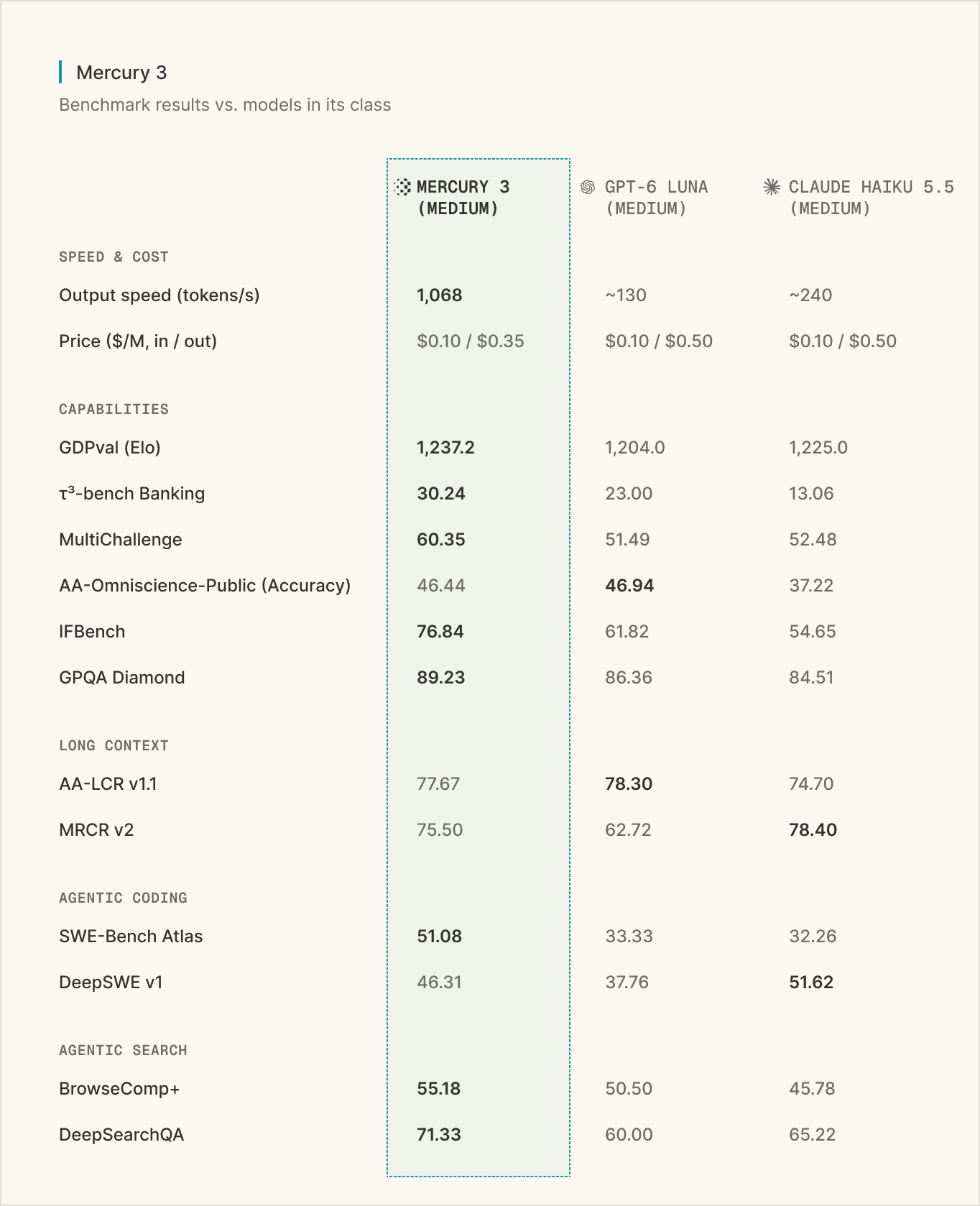
The company also presented results from partners. As a browser-operating agent, it completed 50% of 50 tasks on real websites, outperforming OpenAI's upper-tier model "GPT-6.1 Sol," according to the company.
$0.20 for input, halved to mark the launch
API pricing is $0.20 for input and $0.70 for output per million tokens, halved to $0.10 for input and $0.35 for output to mark the launch. The company has not said how long the half-price period will last. Cached input is discounted 90% from the regular input price. The company's own API offers 100 million tokens free.
| Pricing | Regular | Launch |
|---|---|---|
| Input | 0.20 | 0.10 |
| Output | 0.70 | 0.35 |
Backed by NVIDIA's and Microsoft's investment arms
Inception's investors include U.S.-based Menlo Ventures, M12, Microsoft's investment arm, and NVIDIA's investment arm, as well as AI researchers Andrew Ng and Andrej Karpathy and former Google CEO Eric Schmidt. Diffusion language models remain a minority, and the mainstream approach generates text sequentially. The company is using the speed to open up uses where latency is a problem, such as voice responses and classification. It also offers "Mercury Voice" for voice responses and "Mercury Decide" for classification.


