
computer use becomes generally available
Google on Oct. 30 (Oct. 31 Japan time) made "computer use," a developer feature in which AI looks at the screen and clicks, types and scrolls, generally available (GA) in the Gemini API. It has exited the trial "preview" stage and is now positioned for companies to use in production work. The official account of Google's developer environment "Google AI Studio" announced it on X on Nov. 4 (Nov. 5 Japan time), saying there are no breaking changes from the preview.
the computer use tool in the gemini api is now generally available. no breaking changes from preview, just production-ready stability for your browser, mobile, and desktop agents. docs here: https://aistudio.google.com/docs/computer-use
General availability covers both of Gemini's two ways of calling the model, the Interactions API and the GenerateContent API. The release notes entry is a single line and does not mention supported models or usage limits.
388 days from the first preview
On Oct. 7, 2025, Google released "Gemini 2.5 Computer Use," a model specialized for screen control, in preview. In January 2026, it made the feature available in trial versions of the general-purpose Gemini 3, and on June 24 it built it into "Gemini 3.5 Flash" and expanded it to public preview. At that time, it added support for three environments, browser, mobile and desktop, and safety settings that stop risky operations. It took 388 days from the first preview to general availability.
Among competitors, Anthropic made the same kind of feature generally available on Claude's developer platform on Aug. 19. OpenAI also promoted "GPT-6.1 Terra," released on Oct. 26, as a model to which screen control can be delegated at low cost.
- Dedicated model "Gemini 2.5 Computer Use" released in previewOfficial
- Made available in Gemini 3 trial versions (Pro, Flash)Official
- Public preview in Gemini 3.5 Flash, supporting three environments and safety settingsOfficial
- General availability in the Gemini APIOfficial
- Google AI Studio announces it on XOfficial
Gemini 3.8 Flash recommended, no extra fee
According to the documentation, four models are supported: "Gemini 4 Argon," "Gemini 3.8 Flash," "Gemini 3.5 Flash-Lite" and the trial "Gemini 3 Flash Preview." Google calls 3.8 Flash the recommended model for computer use, positioning Argon for complex tasks and Flash-Lite as a fast, low-cost option. The top-end "Gemini 4 Carbon," announced on Oct. 28, was not on the list as of Nov. 5.
It works by having the developer's app send task instructions and a screenshot to the model, which returns where to click next or what text to type. The app performs the actual operations and sends the resulting screen back to continue the task. In browsers, it also supports operations such as going back to the previous page, and on smartphones, operations such as opening apps and long-pressing.
It cannot be used on the free tier; on the paid tier, the standard token pricing for the model used applies. The recommended Gemini 3.8 Flash costs $0.75 for input and $3.75 for output per 1 million tokens, rising to $1.50 for input and $7.50 for output from Jan. 1, 2027. Gemini 4 Argon costs $2 for input and $10 for output, rising to $4 for input and $20 for output from Dec. 1. OpenAI's GPT-6.1 Terra costs $1 for input and $5 for output, and Anthropic's "Claude Sonnet 5.5" costs $2 for input and $10 for output.
- Input
- Output
Claude leads screen control even in Google's table
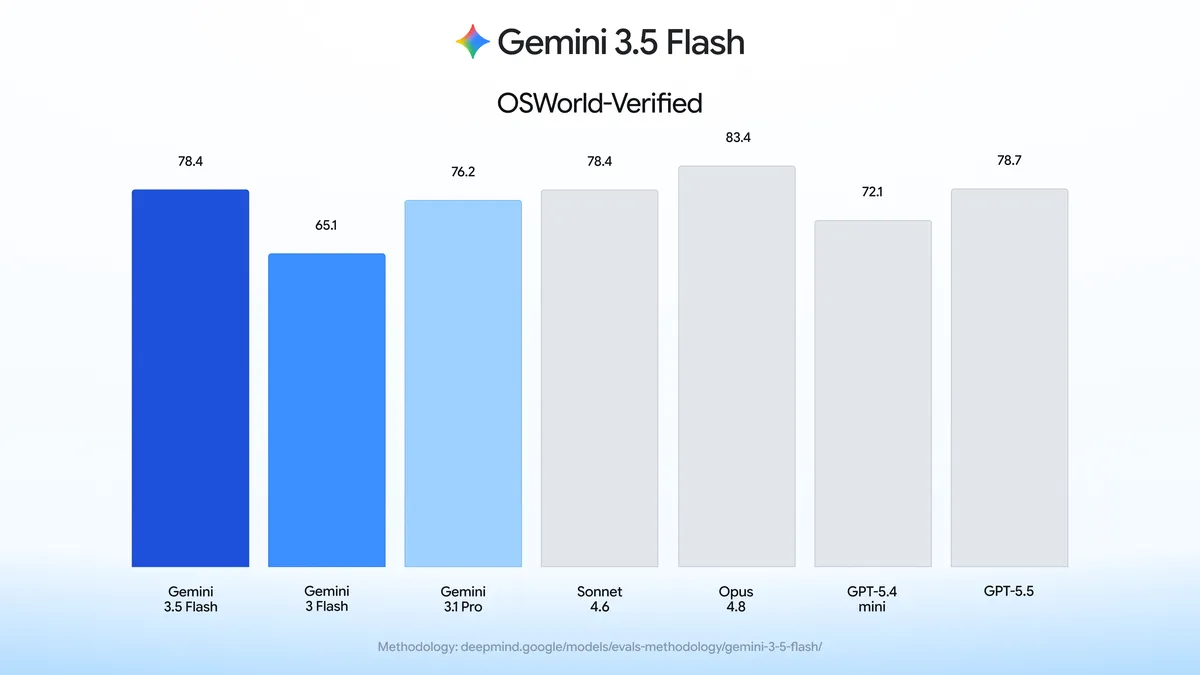
On screen-control performance, Anthropic's models come out ahead even in the table Google published. On "OSWorld-2.1" (out of 100%, offline subset), which measures the share of computer tasks completed, Argon, which supports computer use, scored 74.7%. That is below Claude Opus 5.5's 87.2% and OpenAI's "GPT-6 Astra" at 80.9%. The top-end Carbon scored 81.5%, 0.6 points above Astra.
Recommended 3.8 Flash falls short of rivals' previous-generation top models
The recommended Gemini 3.8 Flash scored 59.0% on "OSWorld-2.0," the previous version of the evaluation. In a table compiled by IT news site Computing for Geeks, that falls short of Anthropic's Claude Opus 5 at 75.4% and OpenAI's GPT-5.6 Sol at 62.6%. It topped Anthropic's Claude Sonnet 5 at 42.6%. Many of the other companies' figures are self-reported, and the measurement conditions are not consistent.
Confirmation required for risky operations; developers responsible for safety
According to the documentation, the model asks the user for confirmation or stops for operations such as financial transactions, changing sensitive data, using communication channels such as email, creating accounts and agreeing to terms of service. Developers can remove some of these policies, but the model may still ask for confirmation. Detection of "prompt injection," which manipulates AI with instructions slipped into the screen, is also available but disabled by default.
Developers provide the environment and the program that carry out the operations. Google recommends running it in an environment isolated from other systems and including steps for human review.
Google Cloud revenue more than doubles
In July-September quarter results announced on Oct. 28 by Google's parent Alphabet, revenue at its cloud business, Google Cloud, rose 103% from a year earlier to $30.7 billion. The volume processed by the API for its own AI models reached about 32 billion tokens per minute, up fourfold in a year.


