
A new model between Carbon and Hydrogen
Google released the AI model Gemini 4 Neon on Nov. 18 (Nov. 19 Japan time). It positions the model as one that completes complex software engineering, knowledge work and science tasks quickly from start to finish while keeping a high level of reasoning. Google began rolling it out the same day in the paid tier of the Gemini API and Google AI Studio, the development tool Google Antigravity, the enterprise offering "Gemini for business," and the Gemini app's paid plans "Google AI Pro" and "Google AI Ultra."
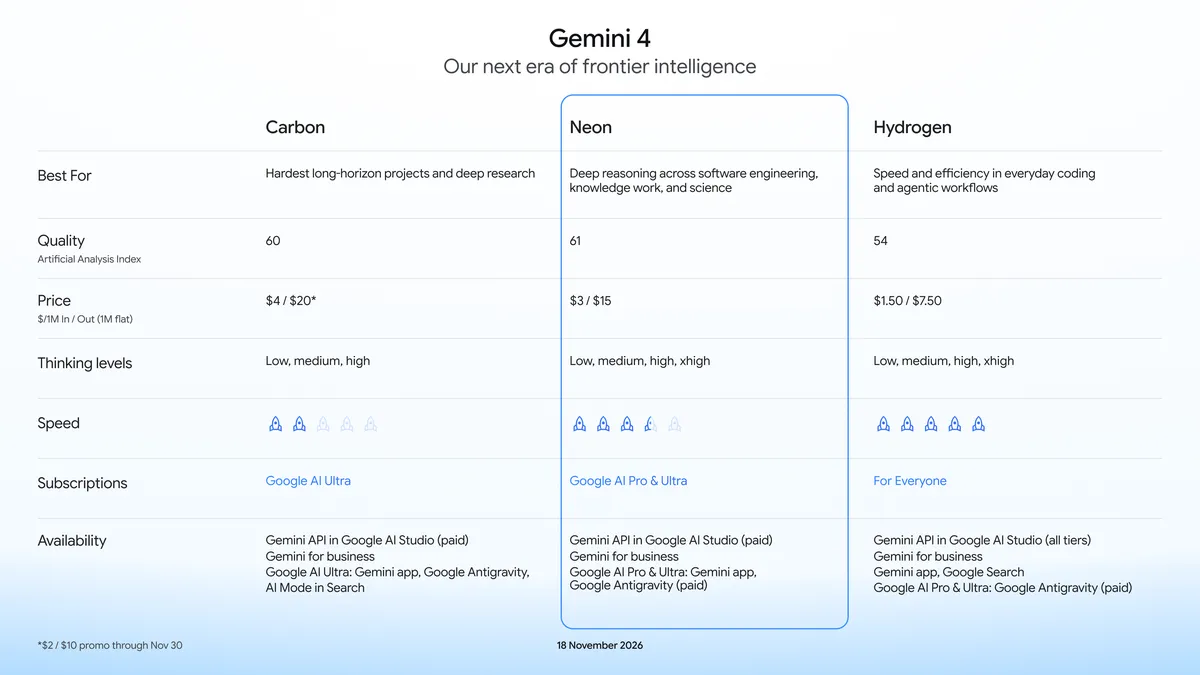
Koray Kavukcuoglu, senior vice president of Google DeepMind and Google's chief AI architect, explained the lineup in the announcement. The top-end Gemini 4 Carbon handles the hardest, longest work, and Gemini 4 Hydrogen, released in November, handles fast everyday execution, while Neon balances depth and efficiency between them, he said.
In the Gemini 4 comparison table Google included in the announcement, Neon scored 61 on the index of U.S. evaluation firm Artificial Analysis, compared with 60 for Carbon and 54 for Hydrogen. Google placed Neon's speed between Carbon and Hydrogen. In the Gemini app, Carbon is for Ultra subscribers, while Neon is available to both Pro and Ultra subscribers.
The Neon name surfaced two days before the release. Early on Nov. 17 Japan time, posts on X reported that the string "gemini-4-neon" appeared in the HTML of the page served by the Gemini web app, and ORIENS confirmed it the same day (earlier article). At that point Google had not announced anything, and it was unknown what the name referred to.
API pricing is $3 input and $15 output
API pricing for developers calling the model from their own services is $3 input and $15 output per million tokens, the units of text the AI reads and writes. Output includes the tokens the model uses to reason before answering. With caching, a discount for repeatedly sent input, input costs $0.15 per million tokens.
According to the Gemini API pricing page, Carbon is offered at a discounted $2 input and $10 output through Nov. 30, rising to $4 input and $20 output from Dec. 1. Neon costs more than Carbon during the discount period and less than Carbon after it ends. Hydrogen costs $1.50 input and $7.50 output.
Google also stressed lower cost per completed task. At the default thinking level (high), Neon's cost per task on Artificial Analysis's evaluation is 32% lower than Carbon's, Google said. On the Vals Index and Agent Arena, its cost per task is roughly 50% to 80% lower than top competing frontier models, according to Google.
- Gemini 4 Hydrogen
- Gemini 4 Neon
- Gemini 4 Carbon (from Dec. 1)
Neon is not available in the free tier of the Gemini API. With the "Batch" and "Flex" processing options, it costs $1.50 input and $7.50 output; with "Priority," it costs $5.40 input and $27 output. The context window is about 1 million tokens. Output is limited to about 65,000 tokens by default and can reach about 1 million tokens with the long-output feature.
Neon tops Opus 5.5 on most items in Google's comparison, but trails on some
Google said Neon scored 61 on the Artificial Analysis Intelligence Index at its deepest thinking setting (xhigh), ranking third overall. Google said the two models above it are larger and slower than Neon. It ranked first with 58.6 on Artificial Analysis's index for coding agents, the "Coding Agent Index."
Google said Neon also ranked near the top in other third-party evaluations. It placed second with 70.9% on the "Vals Index" and second with 1336 on the "Agent Arena Index," a new agent index from the evaluation site Arena. It ranked first overall with 56.3% on Zapier's "AutomationBench," Google said.
The table Google included in the announcement compares Neon with Anthropic's Claude Opus 5.5 and OpenAI's GPT-6.2 Sol across items including coding, knowledge work, science and math, and cybersecurity. Neon scores highest on most items, but on "Terminal-bench 4.1" it scored 65.2% versus 65.8% for Opus 5.5, and on "FrontierCode 2.0" it scored 46.2% versus 47.3% for Opus 5.5. On "Chartography," which measures reading dense charts, Neon scored 73.5% versus 75.1% for GPT-6.2 Sol. On "CursorBench 4.1," Neon scored 65.4% and Opus 5.5 58.1%, with no figure for GPT-6.2 Sol.
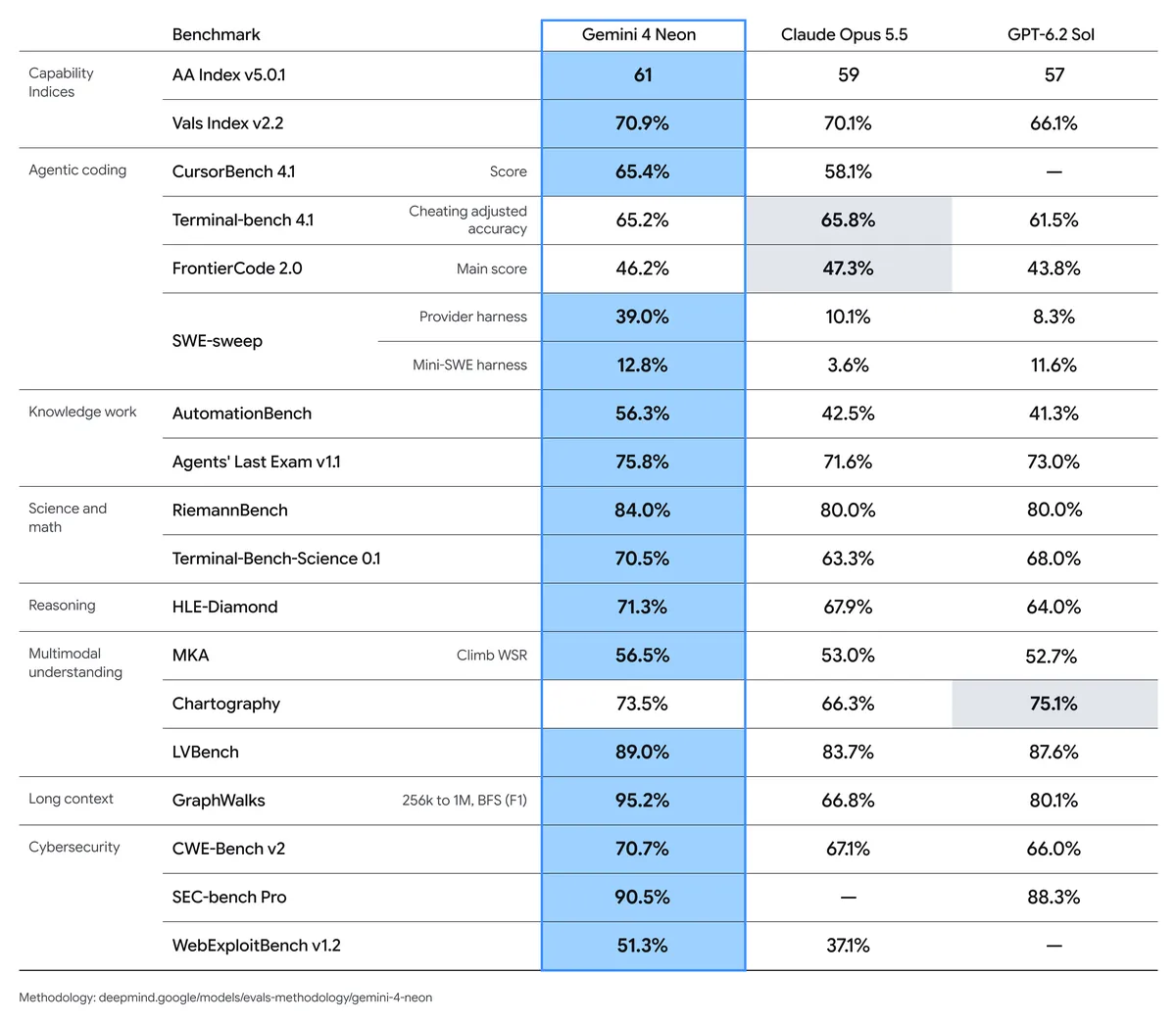
All of these figures come from Google's announcement, and ORIENS has not checked the evaluation sites' leaderboards. The Artificial Analysis Intelligence Index figures from the table are shown below. Neon's 61 is at the xhigh setting, and the table does not state the settings for the other companies' models.
Four thinking levels; cyber defense version offered on a limited basis
Neon lets users choose how deeply it reasons before answering from four levels: "low," "medium," "high" and "xhigh." The default is high, and Google said teams can adjust performance and token use for each workload. Carbon has three levels, from low to high.
In the development tool Antigravity, Neon can run on its own or act as the coordinator directing multiple Hydrogen agents in parallel. On the "SWE-sweep" evaluation, it scored 12.8% in an execution environment called "mini-SWE" and 39.0% when run in Antigravity, according to Google.
For cyber defense, Google said Neon achieved state-of-the-art results of 90.5% on "SEC-bench Pro," an evaluation of finding vulnerabilities, and 51.26% on "WebExploitBench v1.2," a penetration testing evaluation. Google will begin providing Neon for cyber defense to eligible participants in its "Fairwind Program" within the next few days. Organizations apply to the program through their Google Cloud account team.
Gemini app access for paid Pro and Ultra subscribers
Consumers with Google AI Pro or Ultra subscriptions can select Neon from the model menu in the Gemini app. The app's "Tasks" feature, which hands off work to Gemini, can now also run on Neon. Google said it works through jobs faster than larger models and stretches usage limits further.
Developers can use it in the paid tier of the Gemini API through Google AI Studio and the development tool Android Studio. In Antigravity it is available to paid AI Pro and Ultra subscribers, and all Pro and Ultra subscribers can try it in AI Studio. Enterprises can use it in Gemini for business through the API or the model menu, as well as in Antigravity.
Official release two days after the name was found
In the Gemini 4 line, Google announced Gemini 4 Argon on Oct. 1 (Japan time) and Carbon on Oct. 29, and released Hydrogen on Nov. 13. Neon was officially announced two days after its name was found in the web app's HTML.
- Gemini 4 Argon announcedOfficial
- Gemini 4 Carbon announcedOfficial
- Gemini 4 Hydrogen releasedOfficial
- "gemini-4-neon" found in the web app's HTMLLeak
- Gemini 4 Neon releasedOfficial


