
General availability 2 weeks after defender-only release
Google on Nov. 10 (Nov. 11 Japan time) announced it would make its top AI model, "Gemini 4 Carbon," available to developers, businesses, scientists and general users. The API is open to paying developers and businesses, and subscribers to its top paid plan, "Google AI Ultra," will get it gradually in the Gemini app, AI Mode in Search and the development tool Antigravity.
When Google announced Carbon on Oct. 28 (Oct. 29 Japan time), it first offered the model only to vetted cyber defense organizations and said general availability would come as soon as possible (article at announcement). That makes the move to general availability about 2 weeks later. Google positions Carbon as its most powerful model, aimed at difficult work such as complex software development and scientific research. It said the existing Gemini 4 Argon remains well suited to most software development and knowledge work.
API pricing rises to $4 for input and $20 for output from Dec. 1
API pricing for developers building the model into their own services starts at introductory rates of $2 for input and $10 for output per million tokens, the units of text the AI reads and writes. That is the same level as Argon. According to Google's blog, the introductory period ends Nov. 30, and according to the pricing page and developer guide, pricing becomes $4 for input and $20 for output from Dec. 1. At the October announcement, Google had not said how long the introductory period would last.
Output pricing includes tokens for the thinking process before the model answers. Google said Carbon uses more tokens than Argon, so even at the same unit price, the cost of a single request can be higher.
- Through Nov. 30
- From Dec. 1
- Input2 → 4
- Output (including thinking)10 → 20
- Batch input1 → 2
- Batch output5 → 10
According to the pricing page, it is not available on the Gemini API free tier. Discounts for repeatedly sending the same input (caching) apply only through automatic caching, at $0.10 per million tokens, rising to $0.20 from Dec. 1.
Available to paying API users and Ultra subscribers
The API is available to all paying developers and businesses through Google AI Studio and Gemini for business. According to the developer guide, in AI Studio it is available to users of the Gemini API paid tier and Ultra subscribers.
For general users, it will roll out gradually to all Ultra subscribers in the Gemini app, AI Mode in Search and Antigravity. Google's announcement does not mention availability on plans other than Ultra or the countries and regions where it will be offered. It also does not mention availability on Google Cloud's Vertex AI.
Scientists can apply for 6 months of free access to Argon and Carbon at Antigravity's highest usage tier. Applications are reviewed on a rolling basis, depending on eligibility, availability and the results of the review. Google will continue to offer a cyber-focused version of Carbon to cyber defense organizations through the Fairwind Program.
The API can handle up to about 1 million tokens of input and output combined. Output is normally capped at 65,536 tokens, but it can exceed that when submitted as a long-running job. Thinking depth can be chosen from 3 levels. The developer guide says difficult problems can take several minutes and advises setting connection timeouts to 15 to 20 minutes or more.
Google claims top spot on 3 external evaluations, but trails rivals on some
In its blog, Google said Carbon ranked first on Cursor's coding evaluation "CursorBench 4.0," Perplexity's "WANDR" and Zapier's business automation evaluation "AutomationBench," with a cost per task more than 2 times lower than the next-best rival model. The blog does not include scores. On "MKA," a new evaluation of reading drawings and images, it placed second (article on MKA).
The model card lists evaluation results as of October. On AutomationBench, Carbon scored 53.9%, ahead of Anthropic's Claude Opus 5.5 at 42.5% and OpenAI's GPT-6 Astra at 41.4%.
However, the same table also has items where Carbon is not first. On FrontierSWE 2, which solves software development tasks, Carbon scored 61.2% against GPT-6 Astra's 65.5%. On OSWorld-2.1 (offline tasks), which involves operating a computer screen to complete work, Carbon scored 81.5% against Claude Opus 5.5's 87.2%.
Resistance to attacks improves, prompt injection remains a challenge
According to Google, in simulated attacks using an attacker AI agent, the rate of being breached in a single attempt fell from 3.1% for Argon to 0.8%. In external testing by Gray Swan, the rate at which requests for automated cyberattacks went through fell from 9.86% to 2.17%. On the other hand, Google said resistance to "prompt injection," in which the model follows instructions planted in documents or web pages, is an area where it continues to make improvements.
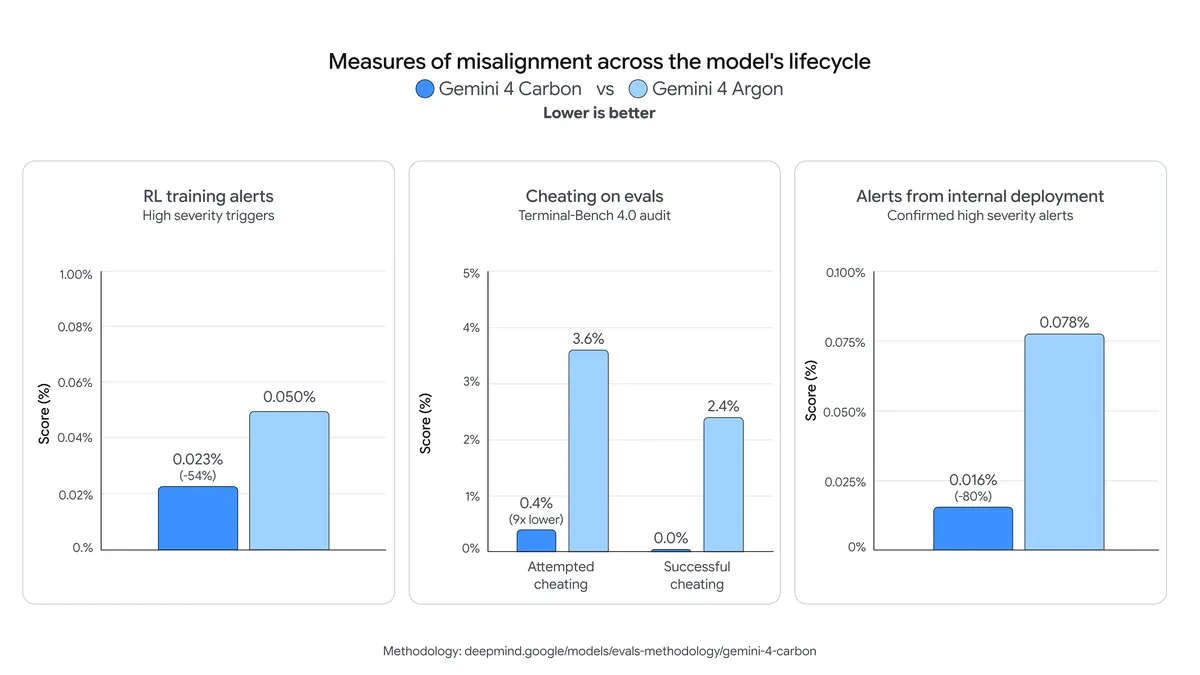
As known limitations, the model card lists giving plausible-sounding but incorrect answers (hallucinations), slow responses or timeouts, and higher token use the deeper the thinking. Its knowledge is based on information through March 2026.


