
Two models released, for recorded audio and real time
Voice AI company ElevenLabs announced new speech recognition (speech-to-text) models "Scribe v3" and "Scribe v3 Live," which turn speech into text, on its official blog on Nov. 10 (the same day Japan time). Scribe v3 is for transcribing recorded audio, and Scribe v3 Live is for real-time transcription of calls and meetings as people speak; the company describes both as its most accurate speech recognition models.
In the model list in the official documentation, Scribe v3 (scribe_v3) is listed as the successor to the previous "Scribe v2," and Scribe v3 Live (scribe_v3_live) as the successor to "Scribe v2 Realtime." Both support more than 90 languages.
Scribe v3 Live is a model that turns speech into text and is a separate product from "Eleven Realtime," a model for voice agents released in October. Eleven Realtime is a speech-to-speech model that combines everything from listening to producing a spoken response in one, and the documentation also states clearly that the two are different.
Error reductions are the company's own measurements, not comparable with figures measured differently
According to ElevenLabs, Scribe v3 for recorded audio makes 27% fewer word errors than the previous Scribe v2 on "FLEURS," an evaluation dataset of speech in 102 languages. The word error rate (WER) fell from 16.94% to 12.38%, with improvements in every language tested, the company said. The blog said errors fell by 42% in German, 23% in English and 34% in Swahili.
For Scribe v3 Live for real time, the blog said that across 102 languages, the error rate that counts misunderstood meaning (semantic WER) was 43% lower and the word error rate 31% lower than Scribe v2 Realtime. The documentation states, under different conditions, that semantic WER was 44% lower across 73 FLEURS languages. The word error rate fell from 5.99% to 3.91% on accented English earnings call audio (Earnings-22) and from 2.13% to 1.71% on European Parliament audio (VoxPopuli).
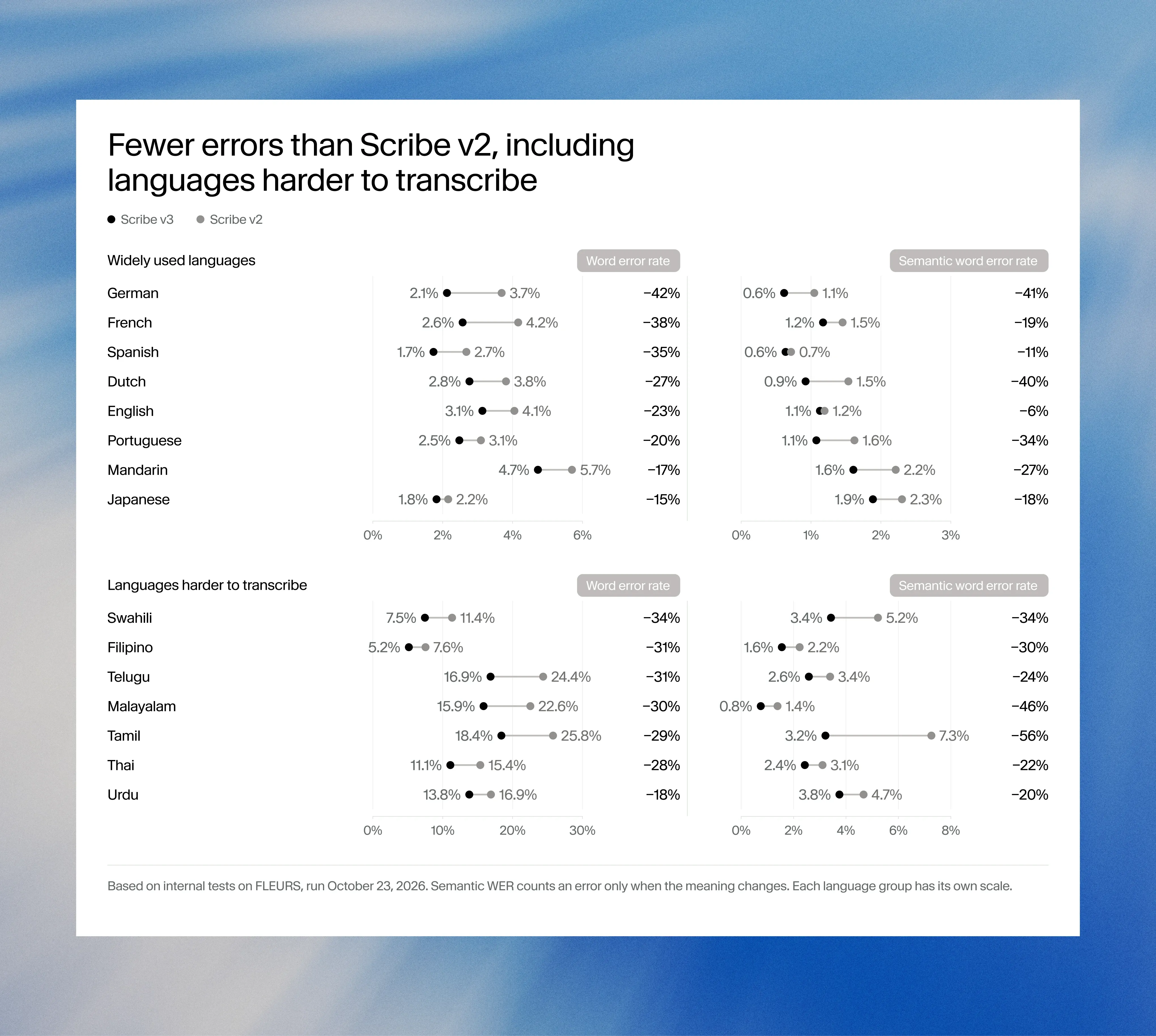
All figures were measured by ElevenLabs itself, and no third-party verification could be found. The company calculates the FLEURS error rate for each audio clip and averages it by language. Because this produces higher numbers than the method used for many published figures, which calculates across all audio together, the documentation cautions that its figures cannot be directly compared with other companies' figures measured by other methods.
- Previous version
- New model
- FLEURS 102 languages (Scribe v3)16.94 → 12.38
- Earnings-22 (Scribe v3 Live)5.99 → 3.91
- VoxPopuli (Scribe v3 Live)2.13 → 1.71
Stronger speaker separation and custom vocabulary
In the feature that distinguishes who spoke in a recording (speaker diarization), Scribe v3 makes 12% fewer errors overall than Scribe v2 and 17% fewer in recordings with three or more speakers, the company said. It can distinguish up to 32 speakers.
Scribe v3 Live makes speaker diarization available in real-time transcription for the first time. On the English portion of an evaluation dataset the company built from meeting and call audio in 16 languages, Live's diarization error rate was 3.1%, below the 5.9% to 7.3% of other real-time models the company tested, it said. The blog notes that this evaluation was measured after aligning each model's transcript to the reference text, which yields lower error rates, so the figures cannot be compared with those for diarization of recorded audio.
The feature that improves recognition of company names, abbreviations and other terms provided in advance allows up to 1,000 terms to be registered for recorded audio. Live can use, in addition to the standard 50 terms, a glossary of up to 10,000 terms (keyterm library) that is referenced only when the terms are heard. It also supports segmenting speech by judging from the flow of conversation whether a speaker has finished, and transcribing conversations that switch languages mid-sentence.
Dutch energy company Eneco tested Live in its voice agent before the announcement. In real calls, the number of times postal codes were correctly recognized on the first attempt rose by 40%, and for house numbers by 15%, ElevenLabs said.
API pricing in the same rows as the previous versions
In the developer API, existing programs can switch by changing the model name to scribe_v3 or scribe_v3_live. The previous versions remain available. The official software development kits (SDKs) do not yet support Live's newly added turn detection, multilingual transcription or glossary, and using them requires connecting directly to the WebSocket endpoint. The default segmentation setting remains the existing "manual," so existing integrations behave the same until the setting is changed.
The two models have become the default in ElevenLabs' apps, and Live is also available from the same day in "ElevenAgents," the company's service for building voice agents. A version of Live tuned for medical conversations will also be offered in ElevenAgents, the company said.
In the API price table, Scribe v3 is $0.20 per hour in the same row as Scribe v2, and Scribe v3 Live is $0.22 per hour in the same row as Scribe v2 Realtime. The feature for providing terms adds $0.05 per hour for recorded audio and $0.08 for Live. Live's glossary costs $0.08 per hour, and editing transcripts of recorded audio costs $0.07 per hour.
For enterprises, data is processed in the United States by default, and for customers with data residency requirements the models are also offered in isolated environments in the European Union (EU), India and Singapore. Customers can choose a setting that deletes audio and text immediately after processing, and the models can be used for work covered by U.S. health information privacy rules (HIPAA) under a contract. The company also accommodates deployment in customers' own environments.


