
Main small model improved in just over a month
Chinese AI company DeepSeek released "DeepSeek-V4.1-Flash-1017," an improved version of its main small model "V4.1 Flash," on Oct. 17. It made the model available in its web service and app and through its developer API, and released the model weights (trained parameters) on Hugging Face and elsewhere. The company said the new version scores higher on evaluations than the previous one, finishes tasks faster and produces shorter output, improving both performance and cost. API pricing and the way the API is called are unchanged from the previous version.
V4.1 Flash was released on Sept. 10, when DeepSeek also announced that it would phase out its higher-tier "V4 Pro." The improved version strengthens the ability to carry development work from start to finish, from building games to creating 3D models, through reinforcement learning that uses the model's own confidence and self-critique as rewards, the company said. It was tuned for use in DeepSeek's development tool "DeepSeek Harness" and in AI coding tools from China's Tencent.
A score of 77 on a coding benchmark, with emphasis on cost per task
According to DeepSeek's announcement, accuracy on DeepSWE (v1.1), which tests solving software development tasks, was 77.0% at the deepest reasoning setting, above the previous version's 74.2%. The cost of solving one task was just under $0.20, down from about $0.50 for the previous version. In the company's chart, top models such as OpenAI's GPT-6 Astra and Anthropic's Claude Opus 5 cost from about $2 to more than $10 per task and also fall short of the 1017 version in accuracy.
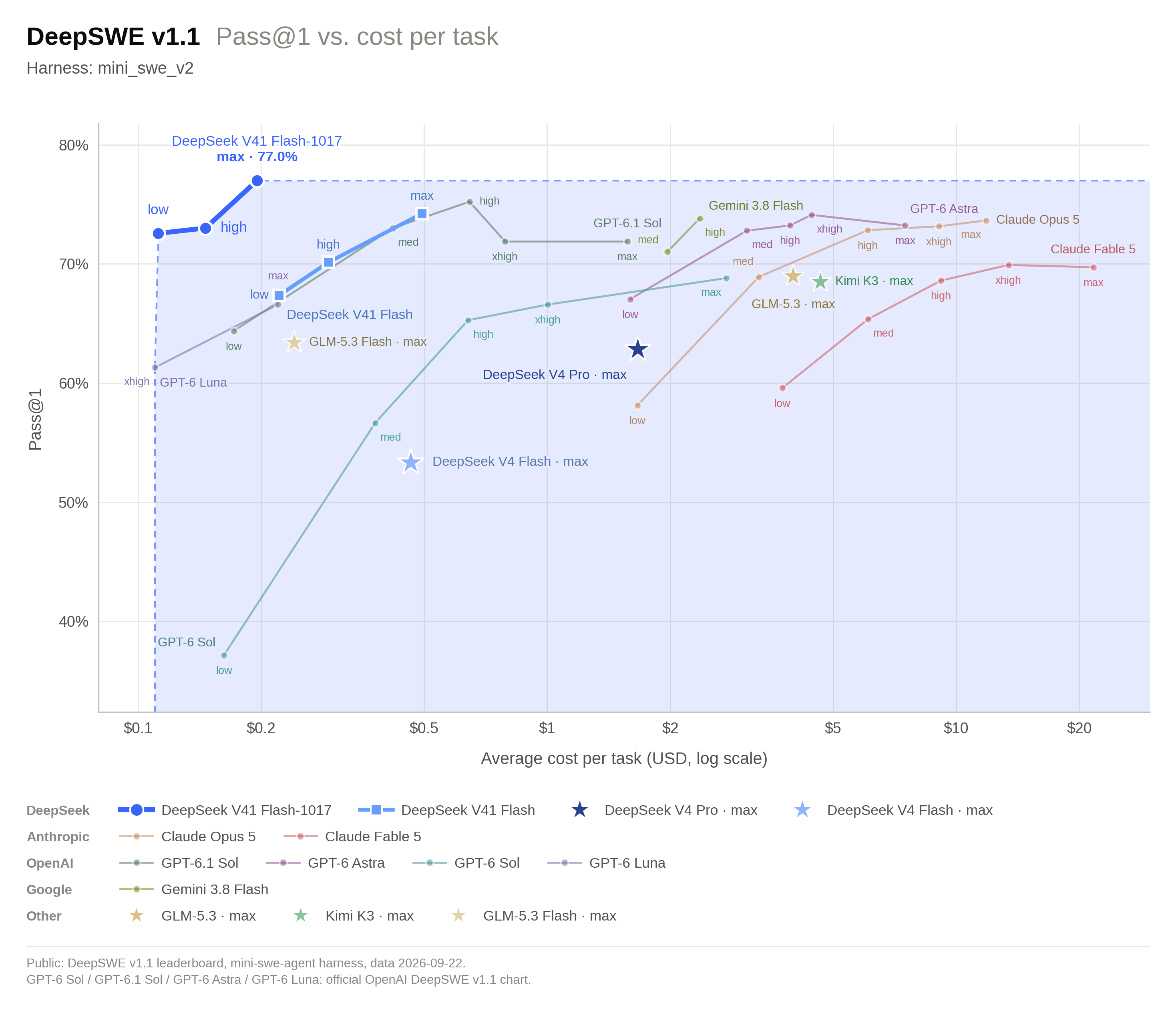
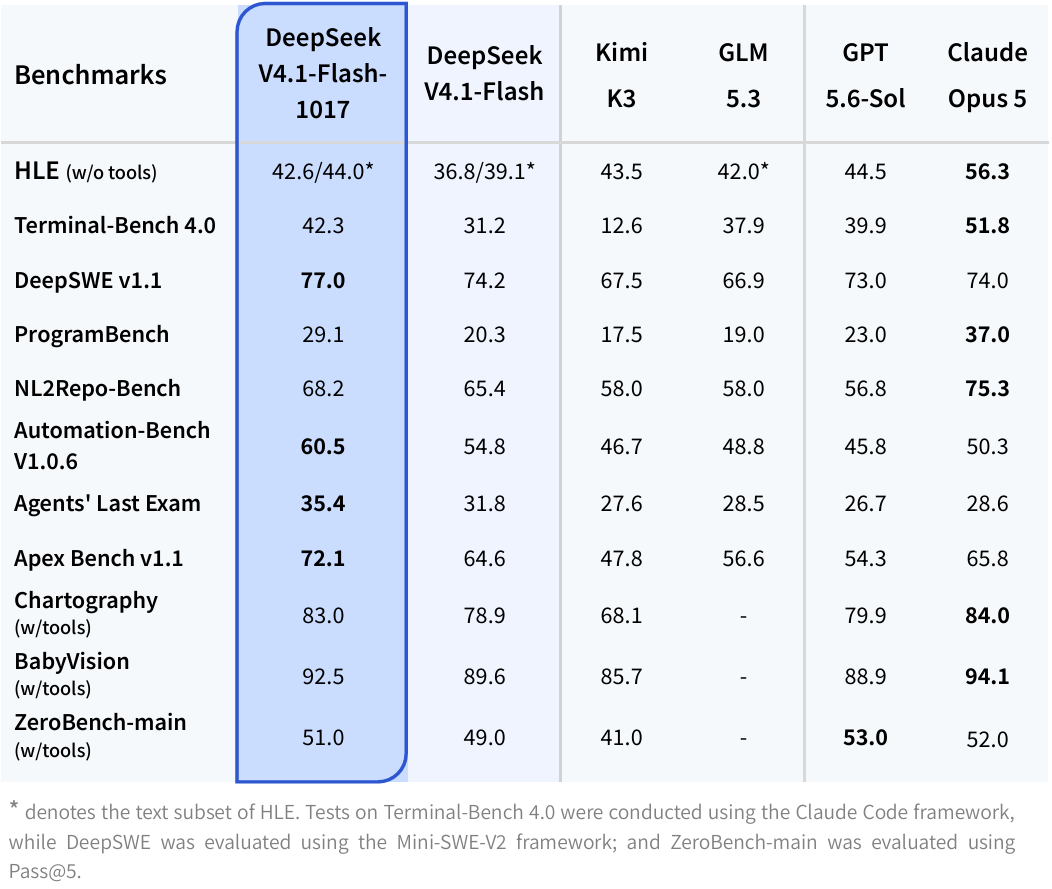
All of these figures were measured by DeepSeek itself. German outlet The Decoder noted that benchmarks show only half of a model's real ability and can diverge from the code quality developers experience.
Third-party overall score of 32, with heavy output
On the overall index (v5.0) of U.S.-based Artificial Analysis, which compares AI models under the same conditions, the 1017 version (at the deepest reasoning setting) scored 32. That is above the median of 23 among models in the same price range. API pricing is $0.30 for input and $1.20 for output per million tokens, cheaper than the median of the comparison group ($0.43 for input and $1.68 for output).
On the other hand, the model output 170 million tokens across all evaluation tasks, well above the median of 100 million. Because it gives long answers to each task, costs may not fall as much as its low per-token price suggests. Output speed was 170 tokens per second.
| Model | Input | Output |
|---|---|---|
| DeepSeek V4.1 Flash 1017 | 0.30 | 1.20 |
| Median of comparison group | 0.43 | 1.68 |
Search API opened to all developers
On the same day, DeepSeek opened its "Search" and "Fetch" APIs, which use its own search engine, to all developers. Each costs $0.75 per 1,000 calls, and use from DeepSeek Harness, Anthropic's Claude Code or OpenAI's Codex was made free until Oct. 31. The company said the search engine handles hundreds of millions of requests a day worldwide.
Cursor adopts it at $0.60 to $0.98 per task
U.S. AI coding tool Cursor made V4.1 Flash available in its editor on Oct. 26 (Oct. 27 Japan time). According to Cursor, on its own coding benchmark CursorBench, all four reasoning-depth settings landed on the line of models that score highest for a given cost.
| Reasoning depth | CursorBench score | Cost per task |
|---|---|---|
| Low | 44.9% | $0.60 |
| Medium | 46.3% | $0.80 |
| High | 45.6% | $0.77 |
| Max | 47.7% | $0.98 |
Cursor's figures are estimates
The costs are estimates from Cursor's evaluation and may differ from actual usage fees. Conditions such as where data is stored were not disclosed.
Report of training on another company's model outputs
U.S. outlet The Information reported on Oct. 28 (Oct. 29 Japan time) that the 1017 version and China's Moonshot AI's "Kimi K3.1 Pro" relied heavily on outputs from OpenAI's "GPT-6 Astra" for training. DeepSeek had previewed the launch of a higher-tier model, "V4.1 Pro," as of September, and on Nov. 1 that name was found in performance evaluation settings.


